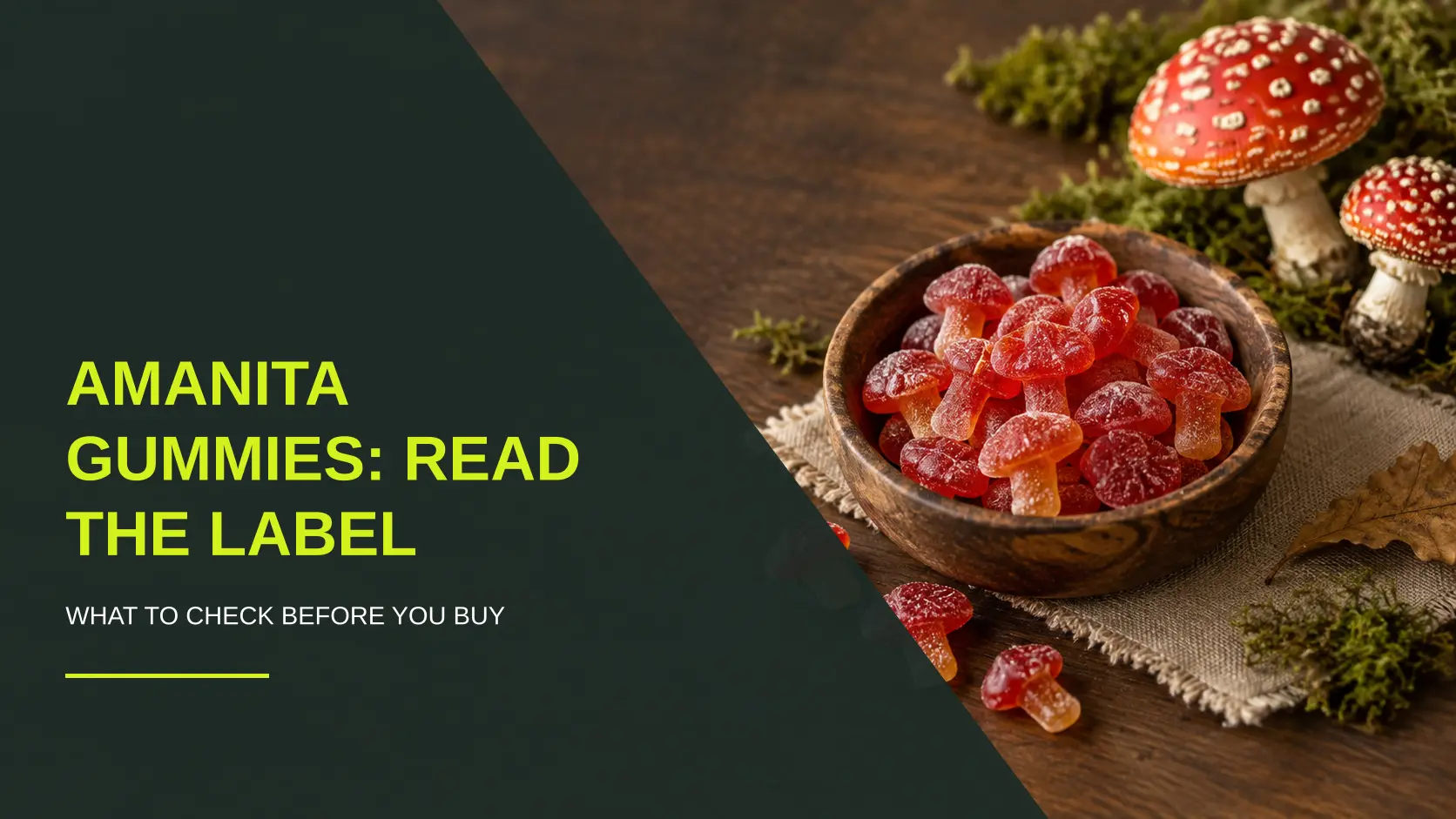
If you've looked at Amanita muscaria gummies lately, you've probably noticed something odd. One package says "500 mg Amanita." Another says "10 mg muscimol." A third just says "mushroom extract" and leaves it at that. The numbers don't line up, and it's hard to tell whether you're comparing similar products or completely different ones.
That confusion is fixable. Once you know what each line on the label means, and how to check it against a lab report, you can pick up almost any package and understand what's inside.
This guide walks through that process the way a friend who's done the reading would: what the mushroom is, what the compounds are, what the label should tell you, what "lab tested" ought to mean, and how gummies stack up against capsules. It's written for adults 21+, whether you're new to Amanita or already familiar with kanna, kava, blue lotus, and other botanicals. If you'd like to see real labels while you read, our Amanita muscaria gummies category is a good place to practice.
Table of contents
- What Amanita muscaria gummies actually are
- How to read an Amanita gummy label, line by line
- What “lab tested” should actually mean
- Understanding serving-size wording
- Amanita gummies vs. capsules: which format fits?
- Are Amanita muscaria gummies legal?
- Quick checklist before you buy
- Frequently asked questions
- The label is the introduction
What Amanita muscaria gummies actually are
The mushroom
Amanita muscaria is the red-capped, white-spotted mushroom from storybooks: the fly agaric. It grows in forests across much of the Northern Hemisphere, usually in partnership with birch, pine, and spruce trees.
Its documented human use is mostly tied to Siberia. Ethnographic accounts from the 18th through 20th centuries describe its use among some Indigenous peoples of the region, including the Koryak and Chukchi of the Kamchatka and Chukotka areas. Those accounts are worth reading on their own terms. They don't translate directly to a gummy sold today. The mushroom also shows up throughout European folklore and art, which is a big part of why it looks so familiar.
Muscimol and ibotenic acid
Two compounds matter most here. The fresh mushroom contains mostly ibotenic acid. When the mushroom is dried or heated, a good portion of that ibotenic acid converts to muscimol through a process called decarboxylation. Muscimol is the compound most people mean when they talk about Amanita products. Ibotenic acid is generally considered the less desirable of the two.
For a gummy, this matters in a practical way. A well-made product is typically formulated to be muscimol-forward, with low residual ibotenic acid, and a proper lab report will show you both numbers so you can see the ratio for yourself. Published reviews of the mushroom's chemistry are a reasonable starting point if you want to go deeper. Our posts on what muscimol is and what ibotenic acid is cover the basics in plain language.
It's worth saying plainly that human research on muscimol at the amounts found in consumer products is limited. Most of what's published comes from older toxicology work or animal studies. Many people report experiences with these products, but "many people report" is not the same as settled science.
Amanita is not a "functional mushroom"
The term "functional mushrooms" usually refers to lion's mane, reishi, cordyceps, chaga, and similar species sold for everyday wellness. Amanita muscaria is a different species with different chemistry, and the two categories deserve different conversations. On a label, "mushroom blend" and "mushroom-inspired" can mean almost anything. If a package doesn't name the species, you don't know what you're holding. Our Mushrooms 101 page sorts out the categories if you'd like more background.
How to read an Amanita gummy label, line by line
Take it one line at a time.
Botanical name and plant part
Look for Amanita muscaria spelled out in full. "Amanita extract" alone isn't enough, since the genus includes many species.
Next, find the plant part. "Fruiting body" or "cap" means the above-ground mushroom, which is where the documented compound content lives. "Mycelium" refers to the root-like network grown on grain or substrate, and it's not what the traditional accounts or the chemistry literature are describing. For Amanita specifically, fruiting body is what you want to see.
Extract vs. whole dried mushroom
Many gummies use an extract rather than ground whole mushroom. You'll see this written as "10:1 extract" or similar, meaning roughly ten parts raw material were concentrated into one part extract.
Extracts are common in gummies because they're easier to work with in a small format. But an extract ratio tells you how concentrated the material is, not how much muscimol ended up in it. Raw Amanita potency varies a lot from mushroom to mushroom, so a 10:1 extract from a weak harvest and a 10:1 extract from a strong one can be very different products.
Milligrams of what, exactly?
This is the part that trips most people up. You'll see three common label styles:
- "500 mg Amanita muscaria": milligrams of dried mushroom material.
- "500 mg Amanita muscaria extract": milligrams of concentrated extract, strength unspecified.
- "5 mg muscimol per gummy": milligrams of the specific compound.
Only the third style tells you the amount of the active compound. The first two describe how much mushroom-derived material is in the gummy, which could correspond to a wide range of muscimol content depending on the raw material and how it was processed.
That doesn't make styles one and two dishonest. They're just less informative on their own, which is why the lab report matters so much. A label that states muscimol per serving is easier to understand and easier to verify, because you can check that number directly against a lab report.
Other ingredients
A quick scan covers the rest. Pectin-based gummies are plant-derived; gelatin-based ones are not, which matters if you're vegetarian. Note the sugar or sweetener, any colors, and allergen statements. None of this affects the Amanita content, but it affects whether the product fits your preferences.
Lot number and best-by date
A lot number is what connects your specific package to a specific lab report. Without one, there's no way to verify anything. The best-by date is a basic freshness check, and if it's missing, that's a small red flag on its own.
Label checklist
- Amanita muscaria named in full
- Fruiting body or cap stated
- Extract ratio, if applicable
- Muscimol per serving stated in mg
- Serving size and servings per container
- Other ingredients and allergens listed
- Lot number and best-by date present
What "lab tested" should actually mean
"Lab tested" on a package is a claim, not proof. Telling the difference takes a few steps.
Third-party vs. in-house
An independent lab has no stake in the result. In-house testing can be perfectly honest, but there's no outside check. When a brand says "lab tested," ask: tested by whom? The lab name should be printed on the report.
What a complete Certificate of Analysis includes
A Certificate of Analysis, or COA, is the actual lab report. For Amanita muscaria gummies, a complete one shows:
- Muscimol, quantified in mg per gummy or per gram
- Ibotenic acid, quantified the same way
- Heavy metals: lead, arsenic, cadmium, and mercury
- Microbial panel: yeast, mold, E. coli, salmonella
- Pesticide screen, where applicable
- The lab's name, the test date, and the lot number tested
If a report shows only muscimol and nothing else, it's incomplete. If it shows a pass/fail with no numbers, it's not very useful.
How to match a COA to your package
Find the lot number on the box. Find the lot number on the COA. They should match. A generic PDF with no lot number, or a lot number that doesn't correspond to anything you're holding, means the testing can't be tied to your product. Treat it as unverified.
A worked example
Dreamer Shrooms Amanita Muscaria Gummies, Strawlicious make a useful practice case. The package holds 15 gummies, each listed at 350 mg of Amanita mushroom extract, for 5,250 mg of extract per package. That's label style two from above: it tells you how much extract is in each piece, not how much muscimol.
So the next step is the report. Open the product page in one tab and our lab results page in another, find the report for this product, and read the two side by side. If you're not sure what each line on the report means, our guide to reading third-party lab results walks through it line by line. That's the whole exercise. Once you've done it once, you can do it with any brand.
Understanding serving-size wording
"Serving" is a label unit, not a personal recommendation
Serving size is set by the manufacturer for labeling purposes. It's a reference point for the numbers on the panel, nothing more. It isn't a statement about what's appropriate for you, and it isn't the same across brands, which is a big reason comparisons feel so confusing. One brand's serving might be a single gummy; another's might be two.
The label directions are your reference. Read them before you open the package, not after.
Starting gently
Beyond "follow the label," the honest principles are simple. Many people choose to begin with less than a full serving where the label allows it. Give it time before deciding anything. Pay attention to your own experience rather than someone else's description of theirs, because effects vary from person to person.
Gummies can usually be cut, which is one reason some people prefer the format when they're starting out. There's no rush, and nobody gets points for moving fast. If you want more on the topic, our guide to microdosing Amanita extract goes into detail.
One more practical note: gummies look like candy. Keep them in locked storage, out of reach of children and pets.
Who should talk to a professional first
If you're pregnant, nursing, taking medication, or managing a health condition, talk with a qualified healthcare professional before using any Amanita product. That isn't boilerplate. Research on muscimol at consumer serving sizes is thin, and data on long-term use is thinner still, so there's real value in a conversation with someone who knows your situation. Our terms and conditions cover the rest.
Amanita gummies vs. capsules: which format fits?
| Gummies | Capsules | |
|---|---|---|
| Mushroom material | Usually extract | Often whole dried powder; sometimes extract |
| Splitting a unit | Easy | Difficult |
| Taste | Flavored, sweet | Neutral |
| Portability | High | High |
| Unit-to-unit consistency | Can be high with a tested extract | Varies more with raw powder |
| Other ingredients | Sugar, pectin or gelatin, colors | Capsule shell, sometimes a filler |
Comparison of Amanita muscaria gummies and capsules by format.
Where gummies tend to win
They're easy to divide and pleasant to taste, and they're more often extract-based. For someone who wants to start small and adjust, that flexibility counts for a lot.
Where capsules tend to win
Capsules skip the sugar, flavoring, and color. They often contain whole dried mushroom powder, which some people prefer as a less-processed format. In some cases they also hold up longer on the shelf.
The honest trade-off
Capsules filled with ground whole mushroom can vary more from one unit to the next, because the raw material itself varies. A well-tested extract gummy can be more consistent, but only when the lab results actually back that up. A gummy with vague labeling and no COA isn't more consistent than anything.
Neither format is better. The right one depends on what you value. Divisibility points toward gummies; a plainer ingredient list points toward capsules and powders. Some people keep both around for different situations.
Are Amanita muscaria gummies legal?
In plain terms: Amanita muscaria is not a federally scheduled substance in the United States. A small number of states have passed restrictions, and Louisiana is one of them. Local rules can also differ from state rules, and laws around botanical, supplement, and plant-based products change over time, sometimes quickly. Our post on whether Amanita muscaria is legal goes through the state and federal picture in more detail.
That puts the responsibility on you to know the current rules where you live before you buy or have anything shipped. Purely Found sells to adults 21+ only, and we ask every customer to confirm their local laws.
Quick checklist before you buy
- Amanita muscaria named in full on the label
- Fruiting body or cap specified
- Muscimol stated in mg per serving
- Third-party COA with a lot number that matches your package
- A clean, readable other-ingredients list
- Clear label directions
- A seller who answers questions directly
Frequently asked questions
What is muscimol?
Muscimol is the primary compound in dried or heated Amanita muscaria. It forms when ibotenic acid in the fresh mushroom decarboxylates. It's the compound most Amanita products are formulated around, and human research on it at consumer amounts is still limited.
How do I know if an Amanita gummy is lab tested?
Ask for the Certificate of Analysis. A credible one comes from a named third-party lab, quantifies both muscimol and ibotenic acid, includes heavy metals and microbial panels, and carries a lot number that matches your package.
Why do serving sizes vary so much between brands?
Because brands use different label units. "500 mg Amanita" describes mushroom material; "5 mg muscimol" describes the compound. A serving set by one manufacturer has no direct relationship to a serving set by another.
Are gummies stronger than capsules?
Format doesn't determine strength. Muscimol content does. A gummy and a capsule with the same lab-verified muscimol figure are comparable regardless of form. Check the COA rather than assuming.
Can I buy Amanita muscaria gummies in Charlotte, NC?
Yes. Purely Found's Charlotte, NC retail location carries Amanita gummies alongside kanna, kava, blue lotus, and mushroom blends, and we have a second North Carolina location in Matthews. Adults 21+ only.
Who should avoid Amanita gummies or talk to a professional first?
Anyone under 21 shouldn't use them. Anyone pregnant, nursing, taking medication, or managing a health condition should consult a qualified healthcare professional before use.
The label is the introduction
A good label introduces the product honestly. It tells you the species, the part of the mushroom, the amount of material or muscimol, and where to find the lab report that backs it up. Now you know how to read one, and how to spot the gaps when a package leaves things out.
If you have questions about a specific product, write to us or stop by one of our North Carolina shops in Charlotte or Matthews. We'd rather talk it through than have you guess.
Feel different. Live curious. That's an approach to exploring, not a promise of any particular experience, and it starts with knowing what you're holding. When you're ready, the Amanita muscaria gummies category is where to look.