
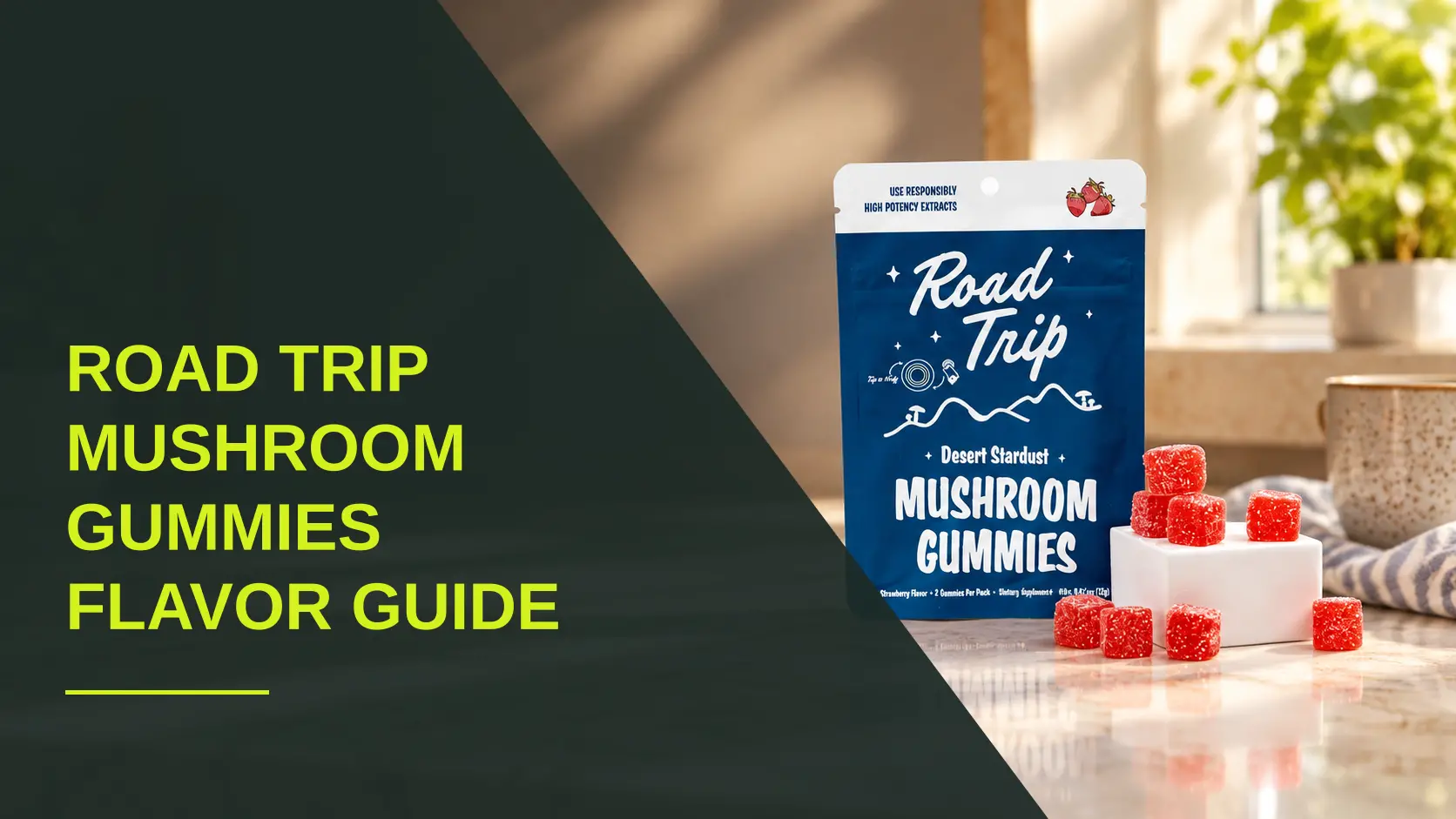
You've probably landed here because you saw Road Trip mushroom gummies in three flavors (Cotton Candy, Strawberry and Blue Raspberry) and the front of the package didn't answer the obvious question: what is in these? That's a fair thing to want settled before you spend money.
This guide covers the Desert Stardust gummies from Road Trip. It explains what "mushroom gummies" can mean, what a blend label does and doesn't tell you, how to read the package step by step, and how the three flavors compare. Formulas and batches can change, so the ingredient panel on the product page and on the package in your hand is always the final word on exact ingredients and amounts. The rest of this guide is about reading that panel so the numbers make sense.
Table of contents
What are Road Trip mushroom gummies?
Road Trip is a brand of mushroom-inspired edibles. At Purely Found, its Desert Stardust line comes as gummies and as chocolate bars. The brand also has a separate collaboration line, Happy Caps x Road Trip Microdosed Gummies, which has its own label and deserves its own read.
This guide sticks to the three Desert Stardust gummy flavors:
What "mushroom gummies" can mean
The phrase covers products that have very little in common. Two packages with similar artwork can belong to different categories.
Functional mushrooms are species such as lion's mane, reishi and cordyceps. They are not psychoactive and are sold for general wellness interest. Published research on these species is still early. Much of it is lab and animal work, with a limited number of small human studies. A label that names them tells you what's inside and little about what to expect.
Amanita muscaria is psychoactive and sits in its own category. Its labels are built around muscimol content, so you read them differently. If that's what you're looking at, our Amanita muscaria gummies category and the muscimol gummies label guide are the better starting points.
Mushroom blends combine several ingredients in one product, sometimes mushrooms alongside other botanicals or added compounds. A blend's name tells you almost nothing, while the ingredient panel tells you nearly everything. Our guide to what mushroom blends are goes deeper on this.
Desert Stardust gummies are a blend product, which is why label reading matters more here than it would with a single-ingredient gummy. You can compare them with the other mushroom blend gummies we carry, online or with the team at our North Carolina locations in Charlotte and Matthews.
Inside the blend: Road Trip gummy ingredients
The ingredient panel on any blend gummy has two parts: the active blend and the gummy base. They answer different questions, so read them separately.
The active blend
This is the part people are paying for. When you open a Road Trip product page or turn the package over, look for four things.
- Which ingredients are named. Specific species names (ideally with the Latin name beside the common one) are more useful than a general phrase like "mushroom extract."
- Which part of the mushroom is used. Fruiting body is the cap and stem. Mycelium is the root-like network, often grown on grain. A label that says which one it uses is giving you real information.
- Extract or powder. An extract is concentrated, and a dried powder is the whole material ground up. The same number of milligrams can mean quite different things depending on which one it is.
- Anything that isn't a mushroom. Blends often include other botanical extracts or added compounds. Look each one up before you buy, because the word "mushroom" on the front doesn't describe them.
If Amanita muscaria appears anywhere on a blend label, read it as an Amanita product first. Amanita Muscaria Gummies: Read the Label First explains what to check.
The gummy base
Everything else on the panel is what makes the gummy a gummy. Sweeteners usually come first, typically sugar and a syrup. Then comes the gelling agent, which matters if you avoid animal products: pectin is plant based and gelatin is not. After that you'll see an acid such as citric acid, flavorings (natural, artificial or both) and colors.
Check the allergen line too. It is usually a short "contains" statement near the bottom, sometimes with a note about shared equipment.
What a proprietary blend does and doesn't tell you
Many blend products list their actives as a proprietary blend. That means you get the ingredient names and one combined weight, with no individual amounts.
You can still learn a couple of things. Ingredients in a blend are conventionally listed from most to least by weight, so the first name is the largest share and the last is the smallest. You also know the total per serving.
What you can't learn is how much of any single ingredient is in a gummy. That limits how well you can compare one product with another, or with amounts used in published research. If a label breaks out each ingredient in milligrams, that is more information than a proprietary blend gives you, and it is reasonable to prefer it.
How to read a Road Trip gummy label
Pick one flavor, open its product page and follow along. The FDA's consumer pages on dietary supplements explain the standard parts of a supplement label, and the same reading habits carry over here.
Step 1: Serving size and gummies per package
Find the serving size before anything else. It is easy to assume one gummy equals one serving, and that is often wrong. Some labels set the serving at half a gummy or even a quarter. Others set it at two.
Then find the count per package. You need both numbers for the next step.
Step 2: Amount per gummy vs. amount per package
The big number on the front of a package is frequently the total for the whole package. First-time buyers miss this more often than any other detail.
To see how the math works, take some made-up numbers (these are not Road Trip's). Say a package front reads 5,000 mg and holds 10 gummies. Each gummy is 500 mg. If the serving size is half a gummy, one serving is 250 mg, a twentieth of the number on the front.
Run the same division on the real label: total amount divided by gummy count, then adjusted for serving size. If the label already states an amount per gummy or per serving, use that figure and ignore the front.
Step 3: Batch number and third-party lab results
A batch number (sometimes "lot number") identifies the production run your package came from. It is usually printed or stamped near the seal or the best-by date.
Third-party lab results arrive as a certificate of analysis, or COA. Many packages carry a QR code that leads to it. A useful COA has three things:
- A batch number that matches the one on your package
- Measured amounts of the active ingredients, which you can compare with the label
- Contaminant screening, typically heavy metals, microbes, pesticides and residual solvents
Check the date and the lab's name while you're there. A COA for a different batch tells you about a different batch. If you can't find results for the package you're considering, ask our team before you order.
Step 4: Warnings, storage and the fine print
Read the manufacturer's warning panel in full. It is short, and it is written for that specific formula.
Store the gummies somewhere cool and dry. Heat can melt them into each other, and once pieces have fused you can no longer tell how much is in a portion. Because they look like ordinary sweets, keep them in locked storage, out of reach of children and pets. Hold on to the original package as well, since it carries the batch number and serving information.
Cotton Candy, Strawberry or Blue Raspberry: comparing the flavors
| Flavor | General flavor style | Where to check the label |
|---|---|---|
| Cotton Candy | Soft and sugary, little tartness | Cotton Candy product page |
| Strawberry | Sweet with mild fruit acidity | Strawberry product page |
| Blue Raspberry | Brighter and more tart | Blue Raspberry product page |
On each page, compare the same three lines: amount per gummy, gummies per package and the full ingredient list.
Cotton Candy
Cotton candy flavoring is a soft, sugary sweetness with almost no tartness. If you find sour gummies sharp, this is the gentlest of the three on paper. Flavorings and colors are where one flavor's base most often differs from another's, so give the ingredient panel a second look if you watch for either.
Strawberry
Strawberry is the most familiar of the three. The flavoring tends to land in the middle: sweet, with a little fruit acidity. It is a reasonable default if you don't have a strong preference.
Blue Raspberry
Blue raspberry is usually the tartest of the group, with a sharper edge. The flavor also leans on added color, so if you avoid certain dyes, read the color line on this one closely.
Flavors in the same line usually share an active formula, but "usually" isn't a label. Put the three ingredient panels side by side. If the active section matches line for line, choose on taste. If it doesn't, the difference you found matters more than the flavor.
Starting gently with Road Trip gummies
Start with the serving on the label, or less. A smaller first portion costs you nothing, and you can't take back a larger one.
Give it real time before you decide anything. Gummies are digested, which is slower and less predictable than most people expect. Taking more because nothing seems to be happening is the most common way people end up with more than they intended.
Effects vary from person to person. Many people report quite different experiences from the same product, and things like body size, what you've eaten and the setting can all play a part. Nobody else's account can tell you how you will respond.
A few practical points:
- The name is Road Trip, but these aren't for the road. Don't drive or operate machinery after taking them.
- Don't combine them with alcohol or other substances.
- Choose a first time when you have nowhere to be, in a place where you're comfortable.
- Write down what you took and when. It makes the next decision easier.
FAQs
What's in Road Trip mushroom gummies?
Desert Stardust gummies are a blend product, so the answer is on the ingredient panel: an active blend plus a gummy base of sweeteners, a gelling agent, flavorings and colors. Each flavor's product page lists the full panel for the current formula.
Are all three flavors the same blend?
Flavors within one line usually share an active formula and differ in flavoring and color, but confirm it yourself. Compare the active section of the Cotton Candy, Strawberry and Blue Raspberry panels line by line before assuming they match.
How many gummies should I start with?
Follow the serving size printed on the label, which may be less than one whole gummy, or start below it. Then wait. Effects vary from person to person, so use your own experience to guide any next step.
Are Road Trip gummies lab tested?
Look for a certificate of analysis linked from the package or product page, and match its batch number to the one on your package. If you can't find results for a specific batch, ask our team before ordering.
What if I take more than I meant to?
Effects vary from person to person and pass with time. If you are worried about how you or someone else is feeling, contact a medical professional or Poison Control.
Read the label, then decide
A blend gummy takes a few minutes to understand: serving size, amount per gummy, the active list and a COA that matches the batch. If those answers satisfy you, pick a flavor. If they raise new questions, bring them to our team online or at our Charlotte and Matthews stores.
Feel different. Live curious. For us, that starts with reading the label and going at your own pace.