

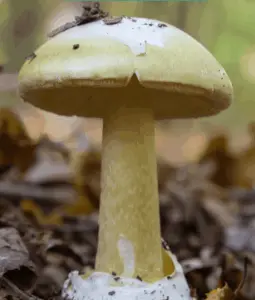
Amanita citrina, known as the false death cap. Admire it, take a photo, and leave it where it grows.
Amanita citrina and Amanita muscaria share a genus, and that is about where the resemblance ends. One has a pale yellow-to-white cap and a nickname, the false death cap, that explains why foragers give it a wide berth. The other is the red-capped, white-spotted mushroom most people picture when they hear "Amanita." This guide covers how to tell them apart, why Amanita citrina should never be eaten, and what to do if someone has eaten a wild mushroom.
What is Amanita citrina?
Amanita citrina is a common woodland mushroom found across Europe and parts of North America. It grows on the ground near trees in summer and autumn. The cap is pale lemon-yellow to nearly white, often with flat, cream-colored patches of veil tissue stuck to the surface. The gills and stem are white. There is a skirt-like ring on the stem, and the base swells into a rounded bulb with a distinct rim. Cut or crush the flesh and you get a smell of raw potato.
It picked up the name false death cap because it looks a lot like Amanita phalloides, the death cap, one of the most dangerous mushrooms in the world. Death cap poisoning can kill, and the early signs often don't show up for hours.
So, is Amanita citrina poisonous? It is not considered an edible mushroom, and it should never be eaten. The bigger risk, though, is the mix-up. If you can't reliably separate a false death cap from a real one in the field, the only safe rule is the one every careful forager lives by: never eat a wild mushroom you have not identified with complete certainty.
Amanita citrina vs Amanita muscaria: how to tell them apart
Side by side, these two are easier to tell apart than the shared genus suggests.
Cap color. Amanita muscaria, the fly agaric, usually has a bright red to orange cap. Some varieties are yellow or orange-yellow, and that is where confusion with Amanita citrina can start. Amanita citrina runs from pale yellow to nearly white. It never shows true red.
Cap surface. The cap of Amanita muscaria carries raised white warts, leftover pieces of its universal veil. Rain can wash them off, leaving a plain red cap. On Amanita citrina the veil remnants are flatter patches, often tinged cream or tan, sitting on a pale cap.
Base of the stem. Amanita citrina has a large, rounded bulb with a clean rim, a bit like a cup. Amanita muscaria's base is bulbous too, but it usually has concentric bands of scaly tissue around it rather than one sharp-edged bulb.
Smell. Amanita citrina smells of raw potato. Amanita muscaria has a mild, unremarkable mushroom scent.
What's inside. Amanita muscaria contains ibotenic acid and muscimol, the compounds behind its reputation as a psychoactive mushroom. Amanita citrina does not; its chemistry is different. That difference matters, but it doesn't make either one a casual snack. A yellow-capped Amanita muscaria variety and a faded citrina can look surprisingly alike on the forest floor, and a wild specimen is only as safe as the identification behind it.
What happens if someone eats Amanita citrina?
Amanita citrina is not an edible species, and eating it can make a person ill. Beyond that, research on this mushroom in people is limited. And because it is so easily confused with the death cap, anyone who eats a mushroom they believe is Amanita citrina can't be certain that is what they actually ate.
That mistake can have serious consequences. Death cap poisoning may seem mild at first and then cause real harm hours or days later. The BC Centre for Disease Control publishes clear guidance on recognizing the death cap and why it is handled as a medical emergency.
If you think someone has eaten a wild mushroom, call Poison Control at 1-800-222-1222 right away. Don't wait for symptoms. If you can, save any remaining pieces of the mushroom in a paper bag for identification, then make the call. Poison Control also offers online guidance if you're unsure whether a situation warrants a call. When in doubt, call.
If you come across Amanita citrina in the woods, treat it like any mushroom you can't name with certainty. Take a photo, note where it grew, and leave it to finish its life cycle.
How Purely Found handles Amanita muscaria
Foraging is where most Amanita trouble begins, which is why Purely Found does not sell foraged mushrooms. Our Amanita muscaria products are made from mushrooms that have been identified to species, dried, and lab tested, with third-party lab results so you can see exactly what you're getting. They are sold to adults 21+ only.
Browse the full Amanita Muscaria collection, or go straight to the format you're curious about: gummies, capsules and powders, or dried mushrooms. New to the species? Our beginner's guide covers what Amanita muscaria is and how the formats differ. Laws around botanical products vary by state and locality, so read up on where Amanita muscaria stands legally and know the rules in your area before you order.
Questions? Stop by one of our North Carolina locations in Charlotte or Matthews, or reach out to the team online.
Frequently asked questions
Is Amanita citrina poisonous?
Amanita citrina is not an edible mushroom and should never be eaten. It is less dangerous than the death cap, Amanita phalloides, but the two look so similar that mistaking one for the other is a serious risk. Never eat a wild mushroom you haven't identified with certainty.
How is Amanita citrina different from Amanita muscaria?
Amanita citrina has a pale yellow to white cap with flat, cream-colored patches, a cup-like bulb at the base, and a raw potato smell. Amanita muscaria usually has a red or orange cap with raised white warts, a base ringed with scaly bands, and a plain mushroom scent. Amanita muscaria contains ibotenic acid and muscimol; Amanita citrina does not.
What should I do if someone eats a wild mushroom?
Call Poison Control at 1-800-222-1222 right away, even if the person feels fine. Death cap poisoning can take hours to show signs. Save any leftover mushroom pieces in a paper bag for identification, and follow the instructions you're given.