Search "amanita muscaria for sleep" and you'll find plenty of confident claims. Most of them run well ahead of the evidence. This explainer covers what Amanita muscaria is, why it gets connected with sleep in the first place, what research does and doesn't show, and what to look for on a label if you decide to explore it. You won't find promises or dosing advice here, just the current picture stated plainly.
What Amanita muscaria is
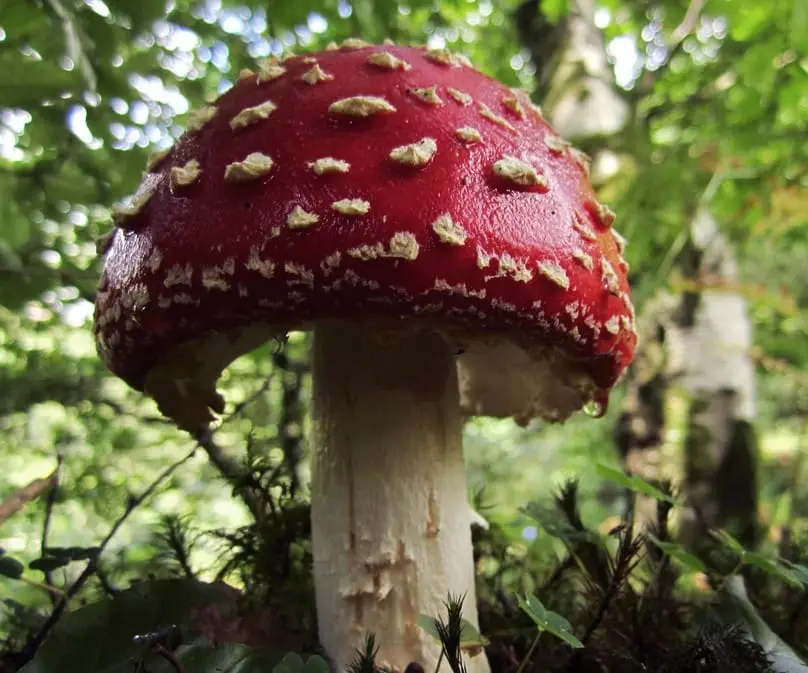
Amanita muscaria is the fly agaric: a mushroom with a red cap and white spots, found in temperate forests across the Northern Hemisphere, usually growing near birch, pine, or spruce. It has a long history in parts of Siberia and northern Europe, where it appears in traditional and ceremonial contexts. That history deserves respect on its own terms rather than being borrowed for marketing.
The two compounds that matter most are ibotenic acid and muscimol. Both act on the nervous system, which makes the mushroom psychoactive. It is not a psychedelic. It works on different receptors from the compounds people usually mean when they use that word, and comparing the two mostly causes confusion. If you're brand new to the topic, the beginner's guide to Amanita muscaria covers the basics in more depth.
Why people connect it with sleep
The link between Amanita muscaria and sleep comes down to one piece of pharmacology. Muscimol binds to GABA-A receptors. GABA is the main inhibitory neurotransmitter in the human brain, and the GABA-A system is also where several prescription sleep medications act. That overlap is why the question keeps coming up.
Overlap at a receptor is not the same thing as an outcome in a person. Different molecules can touch the same receptor and produce very different results, and how a whole mushroom behaves in the body is not the same as how an isolated compound behaves in a lab dish. So treat this section as background on where the idea comes from. It is not a statement about what the mushroom does for sleep.
Ibotenic acid, the other main compound, works on glutamate receptors, a separate and broadly excitatory system. Fresh mushrooms contain more ibotenic acid. Drying and heating convert some of it into muscimol, a process called decarboxylation, which is why the two compounds are usually listed together on product labels.
What research actually shows (and doesn't)
Muscimol has been studied for decades, but mostly as a research tool. Scientists use it to probe how GABA-A receptors work, usually in animals or in tissue samples. Some of that animal research looked at sleep-wake patterns. Animal findings are a starting point for questions, though, not an answer about people.
Here is what is not in the published record:
- Clinical trials in people testing Amanita muscaria or muscimol products for sleep.
- Approval of any Amanita muscaria product by the FDA or any other regulator for sleep or any other use.
- An established, evidence-based serving size for any sleep-related purpose.
Amanita muscaria products are sold as botanicals. Statements about them have not been evaluated by the FDA, and the products are not intended to diagnose, treat, cure, or prevent any disease. Research in people is limited. That is the honest state of Amanita muscaria and sleep research right now. Anyone who tells you otherwise is selling, not informing.
Safety and who should avoid it
Effects vary from person to person, from product to product, and from batch to batch. That variability is the single most important thing to understand before you decide anything.
Amanita muscaria is for adults 21 and older only. Anyone who is pregnant or nursing should not use it. Anyone taking medication, especially anything that acts on the central nervous system, or managing a health condition should talk with a qualified healthcare professional before use.
A few plain rules:
- Don't combine it with alcohol or other substances.
- Don't drive or operate machinery after taking it.
- Store it locked, out of reach of children and pets.
- Don't forage for it unless you have real training. Fly agaric grows alongside other Amanita species, some of which are deadly. The BC Centre for Disease Control's page on death cap mushrooms shows how serious a misidentification can be.
If someone has a bad reaction or takes more than intended, contact a medical professional or Poison Control at 1-800-222-1222 (poison.org). Call 911 in an emergency.
Laws around Amanita muscaria vary by state and locality, and you're responsible for knowing the rules where you live. Is Amanita Muscaria Legal? walks through the current picture.
How to read a label
Because research in people is thin, the label and the lab report are what you actually have to go on. Look for:
Muscimol per serving. Stated in milligrams, with ibotenic acid listed as well. A label that only says "Amanita extract" with no numbers tells you very little.
A certificate of analysis (COA). Third-party lab results should confirm the muscimol and ibotenic acid content and screen for contaminants such as heavy metals and microbial growth. If the seller can't show you one, keep looking.
Decarboxylation. The label should say whether the product was processed to convert ibotenic acid to muscimol, since the ratio between the two changes what you're actually taking.
A full ingredient list, a lot number, and 21+ labeling. These are basics, but they tell you whether the maker is paying attention.
Formats are not interchangeable. Gummies and capsules and powders are typically labeled with muscimol content per serving. Dried mushrooms are a raw material that requires preparation, and they carry more variability from piece to piece. Read each one on its own terms.
Exploring Amanita muscaria at Purely Found
If you've read this far and still want to explore, the Amanita muscaria collection is where to start. Every listing includes third-party lab results and clear labeling. Nothing on the shelf is sold as a sleep product, because nothing has been shown to be one.
The team at our Charlotte and Matthews, NC stores is happy to answer questions about labels, formats, and what the lab reports mean. If you're unsure, ask before you buy.
Frequently asked questions
Is Amanita muscaria proven to help with sleep?
No. There are no published clinical trials in people testing Amanita muscaria or muscimol products for sleep, and no product is approved for that purpose. The interest comes from muscimol's action on GABA-A receptors, which is background pharmacology rather than evidence of an outcome.
What is the difference between muscimol and ibotenic acid?
Both occur naturally in the mushroom. Ibotenic acid acts on glutamate receptors, while muscimol acts on GABA-A receptors. Drying and heating convert some ibotenic acid into muscimol, which is why labels typically list both compounds.
Who should avoid Amanita muscaria?
Anyone under 21, anyone pregnant or nursing, and anyone taking medication or managing a health condition without first talking to a qualified healthcare professional. It should never be combined with alcohol, and you should not drive after taking it.
What should I do if someone has a bad reaction?
Contact a medical professional or Poison Control at 1-800-222-1222. Call 911 in an emergency.