
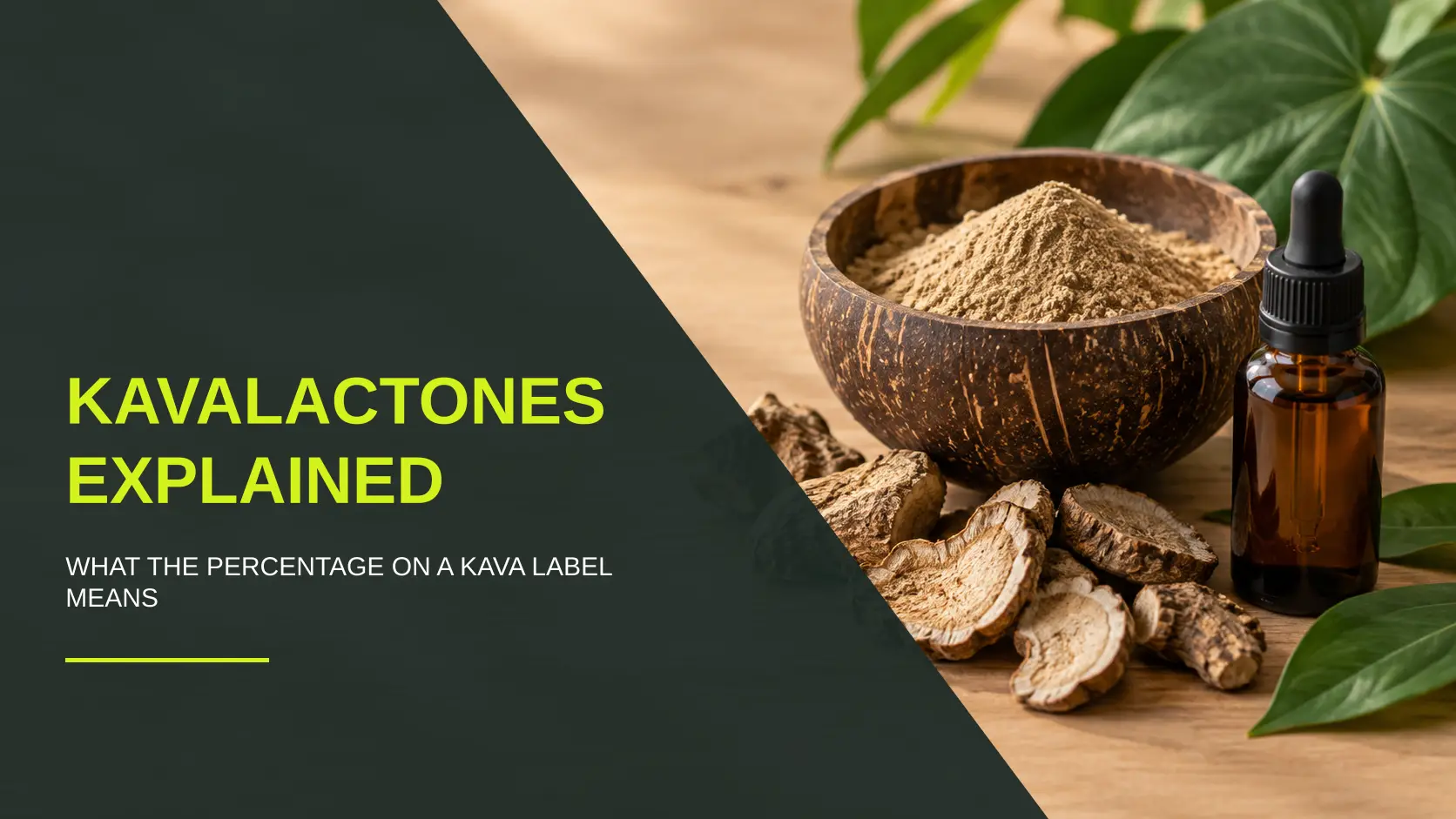
You have two bottles of kava capsules open in separate tabs. Both say “30% kavalactones.” One costs nearly twice as much, the reviews point in opposite directions, and nothing on either label explains the gap.
That’s a pretty normal situation when you’re shopping for kava extract, and it isn’t your fault. The percentage is a real number, but it’s a narrow one. It tells you how much of the powder is kavalactones by weight, and almost nothing about which kavalactones, where the root was grown, or how it was processed. This piece covers what kavalactones are, what “extract” means, why the same number can describe quite different products, and what to look for on a third-party lab report before you buy.
Kava has been prepared as a social drink across the Pacific for a very long time, and many people report a calm, settled feeling from it. It’s also for adults 21 and older, which is the reader we have in mind here.
Table of contents
- What kava is (and where it comes from)
- What are kavalactones?
- What “kava extract” actually means
- How extract percentages are labeled, and what the number leaves out
- How to read a third-party lab report for kava
- Kava tea vs. capsules vs. liquid extract: different formats, different experiences
- Starting gently and paying attention
- Safety notes and open questions
- FAQ
- Back to those two bottles
What kava is (and where it comes from)
Kava is the root of Piper methysticum, a shrub in the pepper family grown across Vanuatu, Fiji, Tonga, Samoa, and other Pacific Island nations. The plant doesn’t produce viable seed. It has been propagated by cuttings for generations, which is part of why distinct cultivars exist from island to island.
The traditional preparation is simple. Fresh or dried root is pounded or ground, kneaded in water, strained through cloth, and shared, usually in the evening and usually with other people. The drink is earthy and a little bitter, and it tends to numb the mouth. Only the root and the lower stump are used. Leaves and upper stems are not part of traditional preparation, and that detail matters more than it sounds once we get to extracts.
In Vanuatu, the cultivars preferred for everyday drinking are called “noble” kavas. The term has a specific meaning tied to the plant’s chemistry, and it comes up again below.
What are kavalactones?
Kavalactones are the compounds in kava root that most people care about. They’re a group of related molecules, and the mix of them in a given root shapes how that root is experienced.
The six major kavalactones
Researchers have identified roughly eighteen kavalactones, but six account for around 95% of the total in most root material: kavain, dihydrokavain, methysticin, dihydromethysticin, yangonin, and desmethoxyyangonin. “Major” just means abundant. The others show up in trace amounts.
Here’s the part labels tend to skip. A root that’s heavy in kavain and a root that’s heavy in dihydromethysticin can carry the same total kavalactone number and still feel different to the person drinking them. Many experienced drinkers describe kavain-forward roots as lighter and shorter-lived, and dihydromethysticin-heavy roots as heavier and longer-lasting. Research on what each individual kavalactone does is still developing, so treat those descriptions as reports from people rather than settled science. A 2020 review in Nutrients gives a good overview of what’s known about kavalactone chemistry and where the gaps are.
Chemotypes, in plain language
Kava researchers use a six-digit code called a chemotype to describe a root’s kavalactone profile. Each of the six major kavalactones gets a number (1 through 6), and the code lists them from most to least abundant. A root coded “426” leads with kavain (4), then dihydrokavain (2), then methysticin (6).
Noble kavas tend toward codes that start with 4 or 2-4. Non-noble varieties, often called “tudei” or “two-day” kavas, tend to lead with dihydromethysticin (5) and dihydrokavain (2). Many people who’ve tried tudei report that the effects run heavier and linger well into the next day, which is roughly where the nickname comes from. Tudei’s safety record is less established than noble kava’s, and reputable vendors avoid it. You’ll rarely see a chemotype printed on a retail label, but a good lab report lets you work it out.
What “kava extract” actually means
Kava comes in several forms, and “extract” is only one of them.
Whole root powder is dried root ground to a traditional (medium) or fine grind. It’s prepared by kneading in water, the way it’s done in the Pacific. Micronized or instant kava is root milled so fine it can be stirred directly into liquid without straining. Kava extract is root material that’s been processed with a solvent to pull out and concentrate the kavalactones, then dried to a powder or kept as a liquid.
Two terms show up constantly on extract labels, and neither is regulated:
- “Standardized” means the extract has been adjusted so each batch lands on a target kavalactone percentage, typically by blending or diluting.
- “Full spectrum” is meant to suggest the extract preserves the root’s natural kavalactone ratio rather than favoring one or two compounds.
Both get used loosely. “Standardized” tells you the total is consistent, not what the mix is. “Full spectrum” is a marketing phrase with no fixed definition.
The solvent matters a great deal. Water, ethanol, CO₂, and occasionally acetone are all used, and each pulls different kavalactones in different proportions. Water tends to extract less of the fat-soluble kavalactones than ethanol does, for instance. This is where the whole “same number, different product” problem starts.
You’ll also see ratios like “10:1.” That means roughly ten parts root went into one part extract by weight. It tells you about concentration, not the kavalactone profile.
How extract percentages are labeled, and what the number leaves out
What “30% kavalactones” means
Thirty percent of the extract’s weight is kavalactones. So a 500 mg capsule of a 30% extract contains about 150 mg of total kavalactones. A 500 mg capsule of a 70% extract contains about 350 mg. That’s the whole calculation.
For comparison, traditional root powder usually lands somewhere in the 3 to 20% range depending on cultivar, age at harvest, and which part of the root is used. A 30% or 70% kava extract is a different animal from a bag of root, and the percentage is useful for telling those categories apart. It’s much less useful for telling two extracts apart.
Six reasons two “30%” products can differ
- Kavalactone ratio, or chemotype. Same total, different mix. A kavain-led 30% and a dihydromethysticin-led 30% are different products that happen to share a number.
- Cultivar. Noble root and non-noble root can both be extracted to 30%. The percentage won’t tell you which one you’re holding.
- Plant part. Root-only extracts are the standard. Some products include stems or leaves, which contain higher levels of compounds called flavokavains. Flavokavain B in particular is the one most people want to see at low or non-detect levels on a lab report.
- Solvent. A water extract and an ethanol extract of the same root will carry different kavalactone proportions, because the solvents don’t pull the same compounds at the same rates.
- Serving size and fill. “30%” on a 300 mg capsule is 90 mg of kavalactones. On a 600 mg capsule it’s 180 mg. Fillers, flow agents, and capsule size all change what you actually consume per serving.
- Batch variation and label rounding. Plants aren’t uniform. A label states a target; a lab report states a measurement. Reputable vendors expect some drift from batch to batch and publish the numbers anyway.
Why milligrams per serving matter more than the percentage
The percentage describes the powder. Milligrams of kavalactones per serving describe what goes into you. When you’re comparing two products, find both numbers on the label, then check them against the lab sheet. If a product only lists a percentage and never tells you the serving weight, you can’t do the math, and that’s worth noticing.
How to read a third-party lab report for kava
“Lab tested” on a label means very little on its own. What you want is the document behind it: a certificate of analysis, or COA, from an independent lab, tied to a specific batch.
Four lines matter most:
- Total kavalactones by HPLC. HPLC is the standard lab method for measuring kavalactones. Does the total match the label within a reasonable margin?
- Individual kavalactone breakdown. Six numbers, one per major kavalactone. Does kavain or dihydrokavain lead? That’s your rough chemotype check.
- Flavokavain screening. Low or non-detect is what you’re looking for, especially for flavokavain B.
- Contaminant panels. Microbial counts and heavy metals, with pass/fail against stated limits.
Red flags: no batch or lot number, no lab name, a total that’s far off the label, or a report that only gives a total with no breakdown.
If you’d like a worked example, the third-party lab results for products sold at Purely Found are posted by batch, so you can see what each of those lines looks like on a real sheet.
Kava tea vs. capsules vs. liquid extract: different formats, different experiences
The format changes more than the strength. It changes the whole character of the experience.
| Format | What it is | Typical kavalactone range | How it’s taken | Taste | What many people report |
|---|---|---|---|---|---|
| Traditional tea / grog | Dried root kneaded in water, strained | Often 3–20% in the raw root | Sipped, usually over an evening | Earthy, bitter, numbing | Gradual onset over 15–30 min; a few hours’ duration |
| Micronized / instant | Finely milled root stirred into liquid | Similar to raw root | Stirred and drunk | Strong, gritty | Faster to prepare; comparable to tea |
| Capsules | Root powder or extract in gelatin or vegetable caps | Extracts often 30–70% | Swallowed with water | None | Slower onset, often 30–60 min; precise serving |
| Liquid extract / tincture | Solvent-based extract in liquid form | Varies widely | Dropped under the tongue or in a drink | Sharp, sometimes alcoholic | Faster onset; shorter duration |
| Concentrate paste | Thick, high-percentage extract | Often 50–70%+ | Measured by the gram | Intense | Strongest per gram; easy to overdo |
A water-based tea and an ethanol extract of the very same root may feel noticeably different, partly because each solvent pulls a different slice of the kavalactone profile. Capsules trade the taste and the slow, social pace of traditional drinking for precision and portability. Neither is better. They’re different tools for different evenings.
If capsules suit how you’d like to explore, the kava capsules collection lists serving weight and kavalactone content on every product page.
Starting gently and paying attention
Whatever format you pick, begin with the lowest serving listed on the label and give it time before you decide anything. One serving, one sitting. Don’t combine formats on the same evening while you’re still learning how a particular product sits with you.
One thing worth knowing in advance: many new kava drinkers report what’s often called “reverse tolerance,” meaning they notice very little the first few times and more on later occasions. If that happens, stay at the same serving and give it a few more occasions rather than reaching for more.
Avoid alcohol with kava. Skip driving or operating machinery afterward. And pay attention to your own experience rather than someone else’s review, because kavalactone profiles, body chemistry, and expectations all vary.
Safety notes and open questions
In the early 2000s, a cluster of liver-injury reports in Europe was linked to certain kava products, and several countries restricted or banned kava for a period. Researchers have debated the cause ever since. Leading hypotheses include the use of stems and leaves rather than root, solvent choice, non-noble cultivars, and co-use of alcohol or other substances. The NIH LiverTox entry on kava summarizes the case reports and the current state of the evidence, and the World Health Organization’s 2007 assessment reached a similarly cautious middle ground. The question hasn’t been settled.
For a buyer, that history translates into a short checklist: noble root only, root-only material, a visible lab report with flavokavain screening, and no alcohol alongside. The Codex Alimentarius regional standard for kava products sets out the same basic expectations for the Pacific region.
Anyone who is pregnant, nursing, taking medication, or managing a health condition should talk with a qualified healthcare professional before trying kava in any form. Laws around kava and other botanical products also vary by state and locality, so it’s on you to know the rules where you live. You can read our disclaimer for the full picture.
FAQ
There's no single right number. A 30% extract and a 70% extract are both fine products if the chemotype is noble and the lab report checks out. Focus on milligrams per serving and the kavalactone breakdown rather than the percentage alone.
Per gram, usually yes, since extracts concentrate kavalactones. But "stronger" isn't the whole story. Many people report that tea and extract from the same root feel different because the solvent changes the kavalactone mix.
Noble refers to cultivars traditionally preferred for daily drinking in Vanuatu, with chemotypes that typically lead with kavain. Non-noble or "tudei" varieties have a less established safety record and are best avoided.
Look for a certificate of analysis from a named independent lab, tied to a batch or lot number, showing total kavalactones, the individual breakdown, flavokavain levels, and contaminant panels. A "lab tested" badge without the document doesn't count.
No. Mixing kava and alcohol is widely cautioned against, and the combination comes up repeatedly in discussions of the liver-injury reports. Keep them on separate evenings.
Back to those two bottles
Those two “30%” products you had open at the start are still 30%. What’s changed is that you now know which three things to check: milligrams of kavalactones per serving, the individual kavalactone profile, and a batch-specific lab report with a flavokavain line. If one bottle gives you all three and the other gives you a number and a promise, the price difference starts to make sense.
Feel different. Live curious. We mean that as a way of exploring, with no forecast attached about what any particular evening will bring. When you’re ready to compare labels side by side, the kava capsules collection and the third-party lab results page are where to start.