
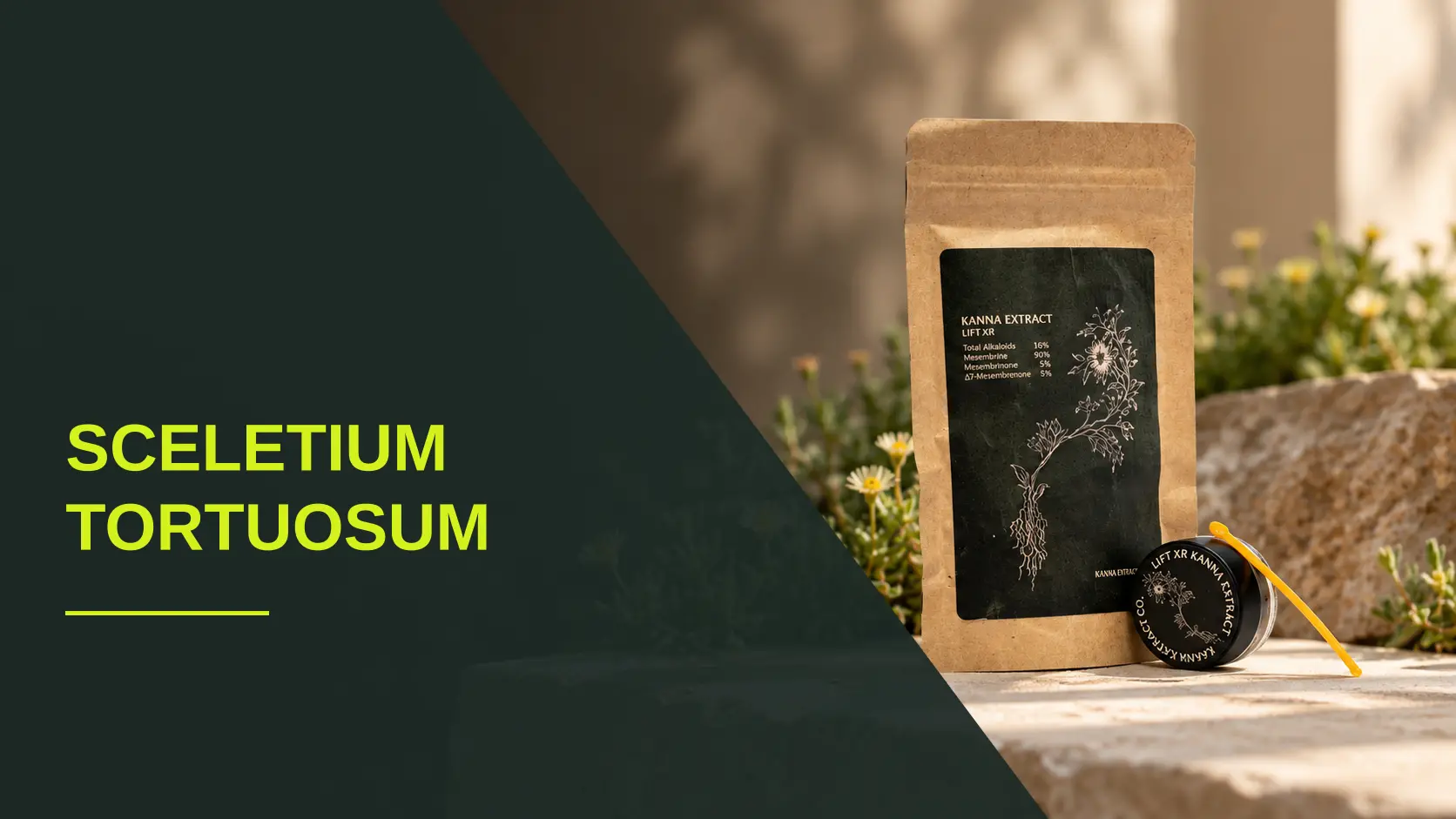
Sceletium tortuosum is the name printed in small type on the back of most kanna products, usually somewhere in the ingredient list. If you've turned a bottle over and wondered what it refers to, the answer is a plant: a low, sprawling succulent from the dry interior of South Africa.
To make sense of a kanna label, it helps to know the plant itself, the region it comes from, the people who used it first, and the steps that turn its leaves into the powders and extracts sold today. For a wider look at formats and how they compare, our complete guide to kanna goes further.
Table of contents
- What is Sceletium tortuosum?
- Where Sceletium tortuosum grows
- A long history of traditional use
- What’s inside the plant: kanna’s alkaloids
- From plant to extract: how Sceletium tortuosum becomes kanna products
- How to read a kanna label
- What people report and how to start gently
- FAQs
- One plant, several formats
Sceletium tortuosum, commonly called kanna, is a small succulent native to the arid Karoo and Namaqualand regions of South Africa. Khoikhoi and San peoples have traditionally chewed its fermented leaves, and today it is dried, powdered, or made into extracts.
What is Sceletium tortuosum?
A low-growing succulent in the ice plant family
Botanists place Sceletium tortuosum in Aizoaceae, the same family as ice plants and the pebble-shaped "living stones" sold at garden centers. It stays close to the ground, creeping outward or scrambling up through neighboring shrubs. The leaves are thick and fleshy, and their surface is dotted with water-storing cells that catch the light. The flowers are pale, usually white to soft yellow and occasionally tinged pink, with a ring of thin petals.
You may also see the plant listed as Mesembryanthemum tortuosum. Some botanists have folded the genus Sceletium into Mesembryanthemum, so newer references sometimes use that name. It is the same plant.
What the name means
"Sceletium" comes from the Latin word for skeleton. As the leaves age and dry out, the soft tissue shrinks and the veins stay behind as a pale, skeleton-like frame. Those dried leaves often stay on the plant and cover the younger growth through the dry season. "Tortuosum" means twisted, which describes the winding stems.
Is Sceletium tortuosum the same as kanna?
Yes. Sceletium tortuosum is the botanical name and kanna is the common one. You'll also see "channa," an older spelling, and "kougoed," an Afrikaans word that translates roughly as "something to chew." Strictly speaking, kougoed refers to the prepared, fermented plant material more than the living plant.
One detail matters if you read labels. The genus Sceletium has several species, and tortuosum is the one behind nearly all commercial kanna. A clear label names it in full.
Where Sceletium tortuosum grows
The Karoo and Namaqualand
The plant is native to South Africa's Cape provinces, mainly the Karoo and Namaqualand. The Karoo is a wide semi-desert stretching across the country's interior. Namaqualand lies to the northwest, running up toward the Atlantic coast and the Namibian border. Both are dry places where rain is scarce and unevenly timed, and both are known for an unusual number of succulent species.
Sceletium tortuosum doesn't sit out in the open the way a cactus might. It tends to grow in the partial shade of larger shrubs, tucked under their branches and out of the full sun.
Wild plants and cultivated crops
For most of its history kanna was gathered from the wild. That has changed. Most of the commercial supply now comes from farms in South Africa, where the plant is grown from selected stock.
Cultivation matters for two reasons. The first is pressure on wild plants: wild stands are limited, and published South African sources have flagged overharvesting in some areas. The second is consistency. Alkaloid content varies a great deal between individual wild plants, so a farm that propagates from known plants and tests its harvests can offer a steadier product. Transparent sourcing starts here. A seller should be able to say where its kanna was grown and how it was processed.
A long history of traditional use
Khoikhoi and San traditions
The Khoikhoi and San peoples of southern Africa used this plant long before anyone bottled it. The best-documented method is chewing: the prepared plant material was held in the mouth and chewed slowly, which is where the name kougoed comes from. Historical and ethnobotanical accounts also describe it being taken as a snuff, smoked, or steeped as a tea.
Those same accounts place kanna in everyday life. It was traditionally used on long treks on foot and shared in social settings, and it was valuable enough to be traded between communities over considerable distances.
Early written records
The first written descriptions come from Dutch colonial sources in the 1600s. The best known is the journal of a 1685 expedition into Namaqualand, which describes the plant, its preparation, and how highly local people valued it.
These are outsiders' notes on practices that were already old, written by people who were also sizing up the plant's trade value. Khoikhoi and San knowledge was passed down orally, so nobody can say how far back the use really goes.
Recognition of traditional knowledge
Modern kanna products exist because of that knowledge, and there has been at least one formal attempt to acknowledge it. In the late 2000s, the South African developer of a standardized kanna extract signed a benefit-sharing agreement with the South African San Council, with a portion directed to Namaqualand communities whose members had shared what they knew. The agreement covers one company's extract, so it isn't an industry-wide arrangement.
What's inside the plant: kanna's alkaloids
Alkaloids are nitrogen-containing compounds that plants produce naturally. Caffeine is one, which gives you a sense of how common they are. Kanna's are often called mesembrine-type alkaloids after the best known of them, and the group also includes mesembrenone, mesembrenol, and mesembranol.
Mesembrine gets most of the attention and is the one you're most likely to see on a label. Our guide to reading mesembrine on kanna extract labels explains what those numbers mean.
How much of each alkaloid a plant contains depends on its genetics, where and how it was grown, and what happened to it after harvest. Two batches of dried kanna can look identical and test very differently.
What research has and hasn't settled
Kanna is psychoactive, and its alkaloids are the reason. Laboratory research has examined how they interact with serotonin signaling and with an enzyme called PDE4. That work shows what the compounds do in a dish of cells, which is a long way from showing what a product does in a person.
Human research exists, but there isn't much of it. The published trials are small, run for weeks instead of years, and mostly use a single standardized extract given to healthy adults. Findings from that one extract don't automatically apply to a powder or a gummy with a different alkaloid profile, and long-term use hasn't been well studied. Research is still early.
From plant to extract: how Sceletium tortuosum becomes kanna products
Between the farm and the shelf, kanna usually goes through four stages. Not every product passes through all of them, and the differences explain a lot about why formats vary so much.
Step 1: Harvest
Growers cut the above-ground parts of the mature plant, mainly leaves and stems. Some traditional preparations used the whole plant, roots included. Alkaloid levels shift as the plant grows, which is one reason careful producers test their harvests.
Step 2: Fermentation
This is the step that most separates kanna from an ordinary dried herb. In the traditional method, fresh plant material is crushed, packed into a closed container (historically a bag made of skin or cloth), and left to ferment for several days, often about a week. The material is then spread out to dry.
Fermentation is thought to change the plant's alkaloid profile. Published chemical analyses support that, though they don't fully agree on which alkaloids rise and which fall. It is also thought to lower the plant's oxalate content. Some modern products skip fermentation altogether, so it's worth checking whether a label says.
Step 3: Drying and milling
Fermented or not, the plant material has to be dried, traditionally in the sun and now often in controlled drying rooms. Once dry, it is milled into a powder. Stop here and you have the simplest kanna product: whole plant material, close to what was traditionally chewed.
Step 4: Extraction and standardization
To make an extract, a producer soaks the dried material in a solvent such as water or ethanol, filters out the plant fiber, and removes the liquid. What remains is a concentrate with more alkaloids per gram than the original powder.
Two numbers describe that concentrate. An extract ratio such as 10:1 means roughly ten parts of plant material went into one part of extract. It tells you how much plant was used. Alkaloid content is a separate number, given as a percentage of total alkaloids or of mesembrine specifically. A standardized extract is one made to hit that percentage batch after batch, with lab testing to confirm it. Our post on kanna extract potency labels and lab results covers this in more detail.
Comparing formats
A dried powder and a concentrated extract can be very different experiences, even though both come from the same plant.
| Format | What it is | What to know |
|---|---|---|
| Dried or fermented powder | Whole plant material, milled | Closest to traditional preparation; potency varies by batch |
| Concentrated extract | Alkaloids concentrated from plant material | Stronger by weight; small amounts matter; check the label |
| Blends and prepared formats | Extract combined with other ingredients | Read the full ingredient list and per-serving amounts |
Capsules, gummies, tinctures, and drinks are mostly different ways of delivering one of these starting materials. You can see how each is labeled across our kanna products, including kanna extracts, and our post on kanna drinks covers beverages specifically.
How to read a kanna label
A clear label answers a handful of questions without making you hunt for them:
- The botanical name, Sceletium tortuosum, written in full
- The plant part used, and whether it was fermented
- An extract ratio, an alkaloid percentage, or ideally both
- The amount per serving in milligrams and the number of servings in the package
- A batch or lot number
- Third-party lab results that match that batch
For blends, read the whole ingredient list. Kanna often shares a formula with other botanicals or with caffeine, and the amount of each should be stated per serving. If a product leaves most of these blank, that tells you something too.
What people report and how to start gently
Many people report that kanna feels different from one format to the next, and that is about as far as a general statement can go. Effects vary with the person, the amount, the alkaloid profile, and whether the product is plain powder or a concentrate. No article can tell you how a particular product will feel for you.
That uncertainty is the reason to start gently. Begin with the smallest serving listed on the label and give it time before deciding whether it suits you. Try one new product at a time so you know what you're responding to. Take extra care with concentrated extracts, where a small change in amount is a large change in alkaloids. There's no rush.
If you take more than you meant to, effects vary and pass with time. Anyone who is worried should contact a medical professional or Poison Control.
Keep kanna in locked storage, out of reach of children and pets. Our format-by-format storage guide covers each type.
FAQs
Is Sceletium tortuosum the same as kanna?
Yes. Sceletium tortuosum is the botanical name for the plant commonly called kanna. Channa and kougoed are other names for it, with kougoed usually referring to the fermented, prepared material. Some newer botanical references list the same plant as Mesembryanthemum tortuosum.
Where does Sceletium tortuosum come from?
It is native to South Africa, mainly the dry Karoo and Namaqualand regions of the Cape provinces. In the wild it grows low to the ground in the partial shade of shrubs. Most kanna sold today comes from cultivated plants grown on South African farms.
What is the difference between kanna powder and kanna extract?
Kanna powder is dried, milled plant material, sometimes fermented first. An extract is made by concentrating the plant's alkaloids, so it contains more of them per gram. The two can be very different experiences, and extract servings are much smaller by weight.
Why is kanna fermented?
Fermentation is the traditional preparation: the plant is crushed, sealed in a container for several days, then dried. It is thought to change the alkaloid profile and lower oxalate content, though published analyses differ on the details. Some modern products are not fermented.
What does a 10:1 kanna extract mean?
It means roughly ten parts of plant material were used to make one part of extract. The ratio describes concentration by weight and does not state alkaloid content. For that, look for a percentage of total alkaloids or mesembrine, backed by third-party lab results.
One plant, several formats
Sceletium tortuosum is a single succulent from a specific corner of South Africa, first prepared by the Khoikhoi and San peoples and now sold as powders, extracts, and prepared products. Knowing how it gets from the Karoo to a label makes those products easier to compare. When you want more on formats, our complete guide to kanna is the next read, and our team is glad to answer questions.
[Read Our Kanna Guide]
[Shop Purely Found]