
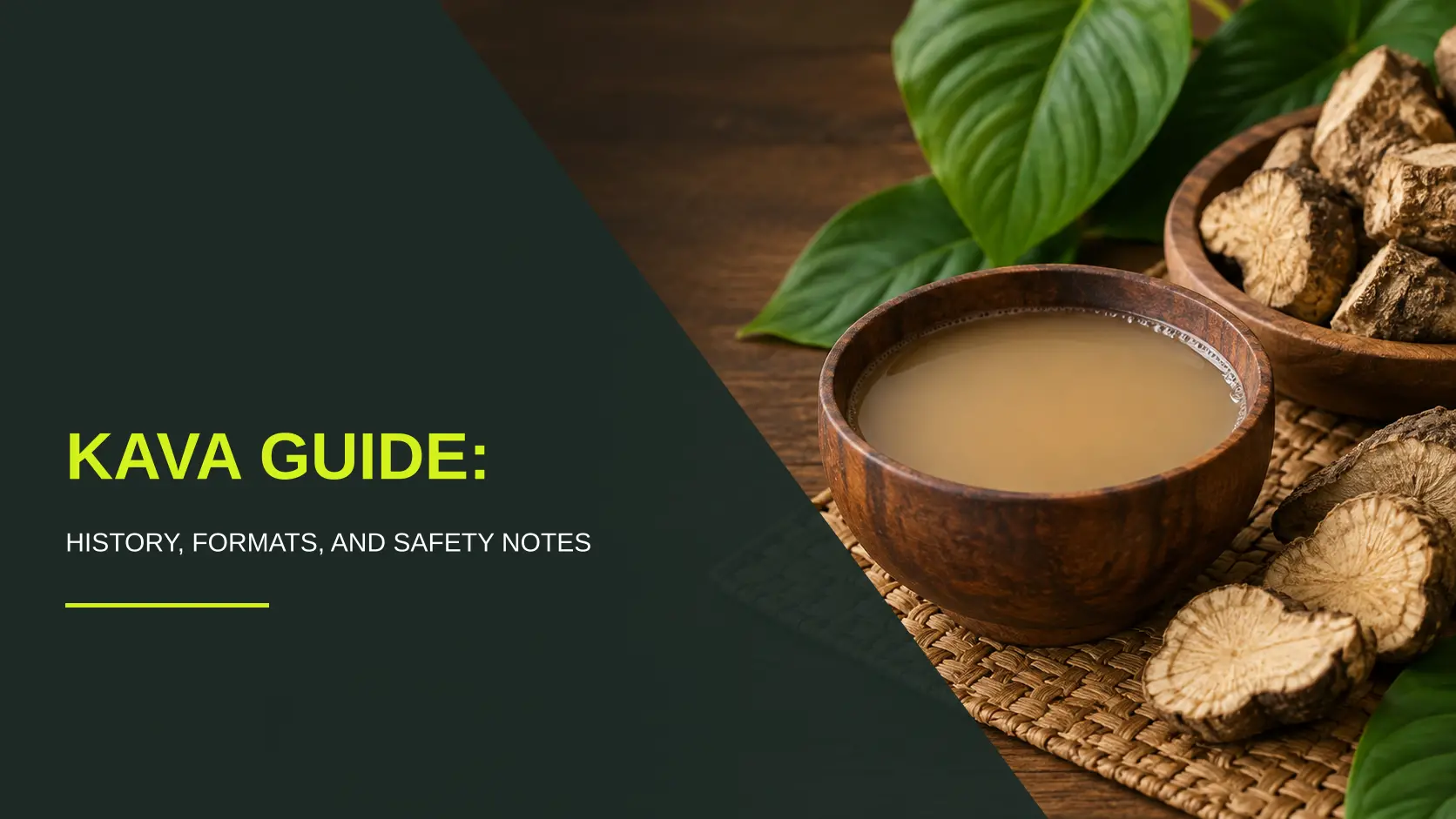
Kava is a plant from the Pacific Islands with a long history of traditional use, and interest in it has grown across the wider botanical wellness world. If you've seen it in a tea, a tincture, or a can at the store and wondered what it actually is, you're in the right place.
This guide covers the essentials: what kava is, where it comes from, what people commonly report, how the many product formats differ, how to read a label without getting lost, and how to explore kava with realistic expectations. Parts of the science are still developing, and where that's true, you'll see it noted rather than smoothed over.
Take your time with it. There's a lot to know, and no rush to know it all at once.
Table of contents
- What Is Kava?
- A Brief History of Kava and Traditional Use
- Where Kava Comes From
- What Kavalactones Are
- What Kava Is Commonly Associated With
- What Does Kava Feel Like?
- Kava Effects: What People Commonly Report
- Kava Benefits: What Research Suggests and What It Does Not Prove
- Kava Safety Considerations
- Who Should Avoid Kava or Speak With a Healthcare Professional First
- Kava and Alcohol, Medications, and Other Substances
- Common Kava Product Formats
- Kava Tea, Kava Drinks, Extracts, Gummies, Capsules, and Powders
- How to Read a Kava Product Label
- What Noble Kava Means
- How to Choose a Transparent Kava Product
- Kava vs. Kratom, CBD, Alcohol, and Other Botanicals
- How Long Kava Effects May Last
- How to Explore Kava Responsibly
- Where to Buy Kava Products
- Frequently Asked Questions About Kava
What Is Kava?
Kava (Piper methysticum) is a plant native to the Pacific Islands, where people have prepared its root into a beverage for centuries. The name gets used three ways at once: for the plant, for the traditional drink, and for the broad category of modern products made from it. That overlap is worth keeping in mind as you read labels and comparisons.
The part that matters most is the root. Traditionally, the dried root and rootstock are ground into a fine powder, mixed with water, strained, and served as an earthy, slightly bitter drink. It's this root, not the leaves or stems, that holds the compounds most associated with kava.
Why the root matters
One early note: traditional kava preparations use the root and rootstock only. The aerial parts of the plant, meaning the leaves and stems, have been linked to safety concerns and aren't part of the traditional beverage. When you're evaluating a product later, "made from root" is one of the first things worth confirming. We'll return to this in the label-reading and safety sections below, but it's the kind of detail that separates a thoughtful product from a careless one.
More than a supplement powder
It helps to think of kava less like a single supplement and more like a small world. A cup prepared at a gathering in Fiji, a concentrated extract in a dropper bottle, and a fruit-flavored gummy are all "kava," but they aren't the same experience, and they don't carry the same considerations. Understanding that range is most of what this guide is about.
If you want the short version: kava is a root-based Pacific Island botanical, traditionally shared as a social beverage, now available in many modern forms. The rest of this page fills in the nuance.
A Brief History of Kava and Traditional Use
Kava's story runs deep across the Pacific. For hundreds of years, communities in Fiji, Vanuatu, Tonga, Samoa, and neighboring islands have cultivated and consumed it, and that history predates any wellness marketing by a very long time. It belongs to those cultures first.
In much of the region, kava is part of daily and ceremonial life: welcoming guests, marking important occasions, and bringing people together to talk and make decisions. Ethnobotanists have documented these practices extensively, and they describe kava as a social and communal drink far more than a solitary one.
Kava in community and ceremony
In many Pacific Island communities, kava is prepared and shared in a specific setting. In Vanuatu, these gathering places are often called nakamals. The drink is served in rounds, people talk, and the evening unfolds at its own pace. Some of that culture has traveled: kava bars now operate in cities around the world, where people gather over shells of kava much as they might over coffee or tea.
This is a living tradition, not an aesthetic, and its origin and history genuinely matter to understanding kava.
Traditional use versus modern wellness products
The kava served in a nakamal, prepared fresh from root and water, is not identical to a concentrated extract or a flavored gummy on a shelf. Modern products vary enormously in how they're made, how concentrated they are, and how closely they resemble the traditional beverage.
That doesn't make modern formats "wrong." It just means the centuries of traditional experience don't automatically transfer to every product. A traditional root beverage has a long track record of customary use. A novel concentrated extract is a newer thing, and deserves its own careful evaluation. Keeping that line clear will serve you well as a reader, and as a shopper.
Where Kava Comes From
Kava grows across the South Pacific, and where it's grown shows up in the final product more than you might expect. Different regions favor different cultivars, meaning distinct varieties of the plant, and those cultivars carry different profiles.
Major growing regions include Vanuatu, Fiji, Tonga, Samoa, and Hawaii. Vanuatu in particular has strict standards around which cultivars may be exported, which reflects how seriously the origin question is taken there. Each region has its own agricultural traditions and its own well-regarded varieties.
Growing regions and cultivars
A cultivar is simply a cultivated variety of a plant, selected over generations for particular qualities. With kava, different cultivars can produce noticeably different experiences, which is part of why a good product will often name its origin or variety rather than just saying "kava." When origin appears on a label, that's usually a sign the maker knows, and cares, where their material came from.
How sourcing affects what you buy
Because cultivar and growing region influence quality, sourcing isn't a marketing detail. It's practical information. A transparent producer can typically tell you where the root was grown, what type it is, and whether it's a noble variety (more on noble kava below). A vague product that can't answer those questions is asking for more trust than it's earned.
We'll build this into concrete buying criteria later in the guide. For now, the takeaway is simple: origin matters, and the best products don't hide it.
What Kavalactones Are
Kavalactones are the naturally occurring compounds in kava root most associated with the plant. If you only remember one term from this guide, this is a good one to keep.
There are several primary kavalactones, with names like kavain, dihydrokavain, methysticin, dihydromethysticin, yangonin, and desmethoxyyangonin. You don't need to memorize them. What's useful to know is that their relative amounts, sometimes called a kava's chemotype, vary from cultivar to cultivar. That varying ratio is part of why different kavas can feel somewhat different from one another.
Why kavalactone content appears on labels
On many modern products, you'll see a stated kavalactone content, often a percentage or a milligram amount per serving. This is essentially a measure of concentration. A traditional root powder has a certain natural range. A concentrated extract may list a much higher percentage because it's been processed to intensify those compounds.
This number is one of the most useful things on a kava label, because it helps you compare products on something more meaningful than flavor or packaging. We go deeper on this in Kava Extract Explained: Kavalactones and Labels, and we'll come back to it in the label-reading section below.
What we do and don't know
Research into exactly how kavalactones work in the body is still developing. Published research reviews have explored their pharmacology for years, but there's still plenty that isn't fully settled. Because of that, the most reliable descriptions rest on traditional use and on what people consistently report, rather than on mechanisms research hasn't nailed down. The picture will sharpen as the science matures.
What Kava Is Commonly Associated With
Traditionally, kava has been associated with social gatherings and conversation: a shared drink that fits its long-standing role in community life across the Pacific. Many modern users reach for it hoping for something similar, a way to mark the end of the day or to share something with friends.
Kava is a botanical, not a treatment. The clearest way to describe it comes in two parts: how it's been used traditionally, and what people commonly report.
On both counts, the throughline is social and easygoing. That's the territory kava is most associated with. Not intoxication, not a cure for anything, and not a promise of any particular feeling. The next two sections get more specific about what people actually describe.
What Does Kava Feel Like?
It varies, and no one can tell you in advance what yours will be. Many people describe kava as social and easygoing, more of a slow evening than a big event. Others notice very little, especially early on. Individual experiences differ quite a bit, and that's not a flaw in the plant or in you.
One thing worth setting straight: kava isn't alcohol, and people who expect an alcohol-like experience often describe something quite different. That gap comes up a lot from newcomers who expected something stronger or fuzzier and found something subtler instead.
The lip-tingle and other physical notes
If you drink the traditional beverage, you may notice a mild tingling or slight numbing sensation on your lips and tongue. This is a well-known feature of fresh kava that many people notice, and it comes from the kavalactones themselves. Some people find it novel; others barely register it. Concentrated products and flavored formats may or may not produce it, depending on how they're made.
Why first sessions may feel subtle
Many first-timers are surprised by one thing: kava is often described as having a "reverse tolerance." Rather than needing less over time, some newcomers report that effects are faint at first and become more noticeable over several sessions as their body seems to adjust. This is commonly reported rather than fully explained by research, so hold it loosely. But it's a useful expectation to have. If your first cup feels underwhelming, that's not unusual, and it's not a reason to take more. Start gently and give it a little time.
Kava Effects: What People Commonly Report
It's helpful to separate the sought-after effects from the unwanted ones, because both matter. Everything below is framed as commonly reported. Individual responses vary, and nothing here is a promise.
Commonly reported wanted effects:
- A social, easygoing quality
- Feeling more conversational in company
- The lip tingle, which some people count as part of the experience
Commonly reported unwanted effects:
- Drowsiness, especially at higher amounts
- Mild digestive upset or nausea
- Dizziness
- Headache
- Temporary lip or mouth numbness that lingers longer than expected
The unwanted effects often relate to taking more than your body was ready for. As with most botanicals, more is not better, and the gentlest way in is usually the smallest reasonable serving.
There are also more serious safety considerations that don't belong on a "common effects" list but matter a great deal, particularly around the liver, concentrated products, and combining kava with other substances. Those get their own careful treatment in the safety section below, and we'd encourage you to read it before trying kava for the first time.
Kava Benefits: What Research Suggests and What It Does Not Prove
The research on kava's benefits is limited and mixed. Reading it carefully is worth the effort.
What emerging research has looked at
Kava has been studied over the years. Published research reviews, along with summaries from the National Center for Complementary and Integrative Health (NCCIH), have examined kava's traditional use and what study participants report. Some studies have reported findings worth further investigation. That's genuinely interesting, and it's why kava remains a subject of ongoing scientific curiosity.
But "worth further investigation" is not the same as "established." Many studies are small, methods vary, and results don't always agree. Emerging research suggests some possibilities. It doesn't hand us tidy conclusions.
What the science does not establish
The limits are clear. Current evidence does not support using kava as medical care, and kava should not be viewed as a replacement for guidance from a qualified healthcare professional or any prescribed medication. Kava is not intended to diagnose, treat, cure, or prevent any disease.
If you are considering kava in relation to a health concern, the right next step is a conversation with a qualified healthcare professional, not relying on a product label or marketing claim.
Claims that go further than this are going further than the evidence.
Kava Safety Considerations
Kava can be approached thoughtfully, and many of the commonly reported effects are mild. But it's a botanical with real considerations, and skimming this section isn't the move. The picture breaks down into a few parts.
Common, usually mild effects
The everyday effects people most often encounter are the ones listed earlier: drowsiness, mild digestive upset, and occasional dizziness. These are generally short-lived and often tied to serving size. Because kava can cause drowsiness, don't drive or operate machinery after using it until you know how it affects you.
Liver-related concerns, in context
You may have read that kava has been linked to liver concerns, and the context matters. Years ago, a number of case reports raised questions about kava and liver injury, prompting advisories from regulators including the FDA. Some researchers have since pointed to contributing factors in certain cases, such as poor-quality material, the use of aerial parts (leaves and stems) rather than root, and other variables, while emphasizing that the full picture isn't entirely resolved.
The practical takeaway is that this remains an area of caution, not a settled verdict in either direction. It's a strong reason to choose noble root-only products from transparent sources, to use kava in moderation rather than in large or daily high doses, and to avoid it entirely if you have liver conditions or drink alcohol heavily. If you have any liver concerns, talk with a healthcare professional first.
Concentrated extracts, long-term and high-dose use
There's also a modern wrinkle. According to data discussed by the CDC, U.S. poison center reports involving kava have increased since 2011. The concerns cluster around commercial products, highly concentrated extracts, and products that combine kava with kratom.
That's a reason for thoughtfulness rather than alarm. Concentrated extracts can deliver far more kavalactones per serving than a traditional beverage, which makes careful serving sizes and label-reading more important, not less. Long-term, high-dose use is where more of the caution lives. Traditional, moderate use of noble root sits at the gentler end of the spectrum; concentrated daily use of an unclear commercial product sits at the other. Knowing where a given product falls on that spectrum is a big part of using kava well.
If you or someone else has taken more than intended, keep in mind that effects vary from person to person and pass with time. Anyone who is worried should contact a medical professional or Poison Control.
Storage
Store kava products in locked storage, out of reach of children and pets. This applies to every format, and it applies doubly to gummies and flavored drinks that don't look like a botanical product.
Who Should Avoid Kava or Speak With a Healthcare Professional First
Some people should steer clear of kava, and others should check with a healthcare professional before trying it.
Consider avoiding kava, or speaking with a professional first, if you:
- Have any liver condition or a history of liver problems. Given the liver-related considerations above, this is the clearest reason to abstain unless a professional advises otherwise.
- Are pregnant or nursing. There isn't adequate safety information here, so the cautious choice is to avoid it.
- Take prescription medications, especially anything processed by the liver, sedatives, or medications for mental health. Interactions are possible, and a professional can advise on your specific situation.
- Are managing any ongoing health condition. A quick conversation with your doctor or pharmacist is a reasonable, low-effort step.
- Drink alcohol regularly or heavily. Combining kava and alcohol is not recommended (more in the next section).
- Are under 21. Purely Found products are for adults 21 and over.
- Plan to drive or operate machinery soon after use.
This is the same due diligence you'd apply to any new botanical: know your own situation, and when in doubt, ask someone qualified before you begin.
Kava and Alcohol, Medications, and Other Substances
Interactions are where a little caution goes a long way. Kava can add to, or complicate, the effects of other substances, so this section is worth reading closely.
Kava and alcohol
Don't combine kava with alcohol. Both can affect how you feel and both involve the liver, and combining them may increase drowsiness and other risks. If you're having kava, make it a night off from drinking. This is one of the simplest and most important safety habits with kava.
Kava and sedatives or medications
Because drowsiness is a commonly reported side effect of kava, combining it with sedatives, sleep aids, or other central nervous system depressants could amplify that drowsiness in ways you don't want. Kava may also interact with a range of medications, including some processed by the liver. If you take any regular medication, talk with your pharmacist or doctor before adding kava. They can give you guidance specific to what you're taking.
Kava and kratom
Kava and kratom are different plants with different profiles, and they're sometimes sold together in combination products. As noted in the CDC data mentioned earlier, these combination products are part of the reason poison center reports have drawn attention. Given the added uncertainty, combining the two isn't something we'd suggest, and it's another reason to favor single-ingredient, transparent products. We compare the two plants directly in the "kava vs." section below.
Common Kava Product Formats
One of the most confusing things for newcomers is just how many forms kava comes in. Each one offers a different balance of tradition, convenience, concentration, and control. The range at a glance:
- Traditional beverage and root powder: the closest thing to how kava has always been consumed; you prepare it yourself from ground root and water.
- Kava tea: a more convenient, tea-bag-style take on the beverage; generally milder and familiar.
- Instant kava: dissolvable powder for a quicker drink without straining.
- Extracts and tinctures: concentrated liquids, often measured by the dropperful; stronger per serving.
- Capsules: pre-measured, flavorless, and convenient, with less control over the experience.
- Gummies: familiar and easy, trading some transparency for convenience.
- Ready-to-drink: canned or bottled kava beverages made for grab-and-go use.
The right format depends on what you're after. If you value the ritual and tradition, root powder or tea makes sense. If you want convenience, capsules or ready-to-drink options fit. If you want precise, stronger servings, extracts do that, but with concentrated products, careful label-reading and moderation matter most. None of these is more "correct" than the others. They just differ, and part of exploring kava is finding which one fits your life.
Kava Tea, Kava Drinks, Extracts, Gummies, Capsules, and Powders
Each format deserves a closer look on its own terms, because the differences are real.
Traditional beverage and root powder
This is the reference point. Ground noble kava root is mixed with water, kneaded, and strained to produce an earthy, bitter drink. It's the format with the longest track record of traditional use, and it gives you full visibility into your single ingredient. The trade-offs are effort and taste: preparation takes a few minutes, and the flavor is an acquired one. For many people, that ritual is part of the appeal. You'll find ground root options in our kava powder collection.
Kava tea and instant kava
Kava tea offers much of the beverage experience with less fuss; steep it like any tea. Instant kava dissolves into water without straining. Both prioritize convenience and tend to be milder and more approachable than concentrated products, which makes them friendly starting points. The trade-off is usually a less customizable experience than preparing traditional root.
Extracts and tinctures
Extracts and tinctures are concentrated. A few dropperfuls can deliver a meaningful amount of kavalactones, which makes them efficient and precise, but also the format where careful serving sizes matter most. This is exactly the category the safety section had in mind when discussing concentrated products. If you choose an extract, read the label closely, start with the lowest suggested serving, and don't rush to take more.
Capsules, gummies, and ready-to-drink
These trade some transparency and control for real convenience. Capsules are flavorless and pre-measured. Gummies are familiar and easy. Ready-to-drink kava beverages are grab-and-go. The main thing to watch is label clarity: flavored, processed formats can sometimes obscure how much kava you're actually getting, and vague "blend" language is more common. If you like these formats, favor brands that clearly state kavalactone content, source, and whether they use noble root.
How to Read a Kava Product Label
If there's one skill that will serve you across every kava purchase, it's label literacy. A good label tells you what you're getting. A vague one asks you to guess. The key elements follow.
Kavalactone content and serving size
Start with the numbers. A transparent product states its kavalactone content, as a percentage, a milligram amount per serving, or both, alongside a clear serving size. Together, these tell you how concentrated the product is and how much you'd actually consume per serving. Without them, you're flying blind on the single most important variable.
Clear versus vague blend language
Watch how the ingredients are described. "Noble kava root, [named origin]" is clear. A "proprietary blend" with no breakdown is not. Vague blend language isn't automatically disqualifying, but it shifts a lot of trust onto the brand, and there's usually a more transparent option available. When a label won't tell you what's in it or how much, that's information too.
Third-party testing and sourcing
The strongest labels point to third-party testing, meaning independent lab verification of what's in the product. Look for a Certificate of Analysis, batch testing, or clear language about lab verification. If you've never read one before, our guide on reading third-party lab results walks through it, and you can see examples on our lab results page. Alongside that, look for sourcing details: where the root was grown, the cultivar or variety, and confirmation that it's root, not aerial parts. A brand that shares all of this is telling you it has nothing to hide.
Put simply, a transparent label answers four questions without you having to ask: How concentrated is it? What exactly is in it? Where did it come from? And has anyone independent checked? If a product answers all four, it's earned a closer look.
What Noble Kava Means
You'll see "noble kava" on quality products, and it's a term worth understanding. Noble kava refers to specific, traditionally preferred cultivars that have a long history of daily use in the Pacific and are generally regarded there as the appropriate varieties for regular drinking.
The contrast is with non-noble varieties, including what's often called tudei kava, a name derived from "two-day," referring to reports that its effects can linger uncomfortably long. Tudei and other non-noble cultivars have different chemotypes and aren't the traditional choice for regular consumption. Regional export standards, such as those in Vanuatu, distinguish noble varieties specifically for these reasons.
For a shopper, "noble" is a useful signal. It suggests the producer is using a traditionally consumed, generally preferred variety rather than whatever was cheapest to source. It doesn't replace the other checks; you still want stated kavalactone content, testing, and clear sourcing. But it's a meaningful mark of quality that thoughtful brands tend to highlight. When you see it, it's a small sign that someone was paying attention.
How to Choose a Transparent Kava Product
Pulling the last few sections together, this is a practical checklist for choosing a kava product you can feel good about. A transparent product typically:
- Names its origin or cultivar rather than just saying "kava"
- States kavalactone content and a clear serving size
- Specifies noble kava where applicable
- Points to third-party testing or a Certificate of Analysis
- Confirms it uses root, not leaves or stems
- Uses clear ingredient language, not vague proprietary blends
- Offers sensible serving guidance so you can start gently
You won't always find every box checked, but the more a product clears, the more confidence you can have. The best brands make this easy, because transparency is something they want you to notice.
When you're ready to look, our kava collection is curated with these same criteria in mind.
Kava vs. Kratom, CBD, Alcohol, and Other Botanicals
Kava gets mixed up with a lot of other things. Below is how it compares to the botanicals and substances people most often ask about, with plain distinctions and no product-bashing.
| What it is | How it's commonly described | |
|---|---|---|
| Kava | Pacific Island root beverage/botanical | Many describe it as social and easygoing |
| Kratom | Southeast Asian tree leaf (Mitragyna speciosa) | Different plant, different profile entirely |
| Alcohol | Fermented/distilled intoxicant | Intoxication; a different experience |
| CBD | Hemp-derived cannabinoid | Non-intoxicating; a different category |
| Kanna | Southern African succulent | Its own history of traditional use |
| Blue lotus | Aquatic flower | Its own history of traditional use |
| Functional mushrooms | Fungi like lion's mane, reishi | Non-intoxicating; often used in daily routines |
Kava vs. kratom
This is the most common mix-up. Kava and kratom are entirely different plants. Kava is a Pacific Island root; kratom comes from a Southeast Asian tree leaf. They have different compounds, different profiles, different legal pictures, and different safety considerations. They're sometimes sold together in combination products, but as noted earlier, combining them adds uncertainty we'd rather you avoid.
Kava vs. alcohol
People sometimes reach for kava as a non-alcoholic option for a social evening. The key difference is that kava is not alcohol and isn't associated with the intoxication alcohol produces; people describe the two very differently, and individual experiences vary. That said, the two should never be combined, and kava isn't simply "alcohol without the downsides." It's its own thing, with its own considerations.
Kava vs. CBD, kanna, blue lotus, and functional mushrooms
These are all separate botanicals with their own histories and profiles. CBD is a non-intoxicating hemp compound, and a different category from anything on this page. Kanna is a southern African succulent with its own history of traditional use. Blue lotus is an aquatic flower with its own history of traditional use. Functional mushrooms, such as lion's mane and reishi, are a different category entirely; our post on what mushroom supplements are explains the term and how it differs from other mushroom products. Kava sits alongside these, not above or below them. The right one depends on what you're exploring and how your body responds.
How Long Kava Effects May Last
Timing varies, so treat any range as a general guide rather than a promise. What many people report:
- Onset: Effects from the beverage or an extract may begin within roughly 15 to 30 minutes, though this varies.
- Duration: Effects may last a couple of hours, sometimes longer, depending on format, serving size, and the individual.
- Format differences: Concentrated extracts may come on faster and feel stronger per serving. Capsules and gummies pass through digestion first and may take longer to be felt.
Your own experience depends on how much you take, which format you use, whether you've eaten, and simply how your body responds. Because of the "reverse tolerance" many newcomers describe, your sense of timing may also shift over your first few sessions. The best approach is to try it when you have no obligations, pay attention to your own timing, and take notes if you like. That personal record is more useful than any general range.
How to Explore Kava Responsibly
If you've read this far, you already have most of what you need. The approach comes down to a few guidelines.
Start gently. Begin with the lowest suggested serving of a mild format, and give it time. You can always have a little more next session, but you can't un-take too much. With kava especially, patience is rewarded.
Read the label. Use the checklist from earlier. Know your kavalactone content, your serving size, your source, and whether it's noble root. A minute of reading saves a lot of guessing.
Choose transparent products. Favor brands that tell you where their kava came from and back it with testing. Transparency is the single best filter you have.
Don't mix. No alcohol, no sedatives, and caution with any medication; check with a professional if you're unsure. This is the safety habit that matters most.
Pay attention to how your body responds. Notice how you feel, and let that guide you more than any label promise. Everyone's different, and your own experience is the best teacher.
Give it a rest. Kava suits occasional, mindful use better than daily high-dose habits. Moderation keeps it in the gentler part of the range.
Store it properly. Locked storage, out of reach of children and pets, every time.
Know your local laws. Laws around botanical and plant-based products vary by state and locality, and you're responsible for knowing the rules where you live.
That's it. No ritual required, no belief system to adopt, just curiosity paired with care. Start gently, learn as you go, and see what works for you.
Where to Buy Kava Products
Where you buy matters as much as what you buy. The best sources are transparent and testing-forward: they name their sources, publish or provide lab results, specify noble root, and describe their products in clear language rather than vague blends.
Whether you shop with us or elsewhere, bring the same criteria: stated kavalactone content, clear serving guidance, third-party testing, confirmed root material, and honest sourcing. A trustworthy seller makes those things easy to find because they want you to look.
At Purely Found, kava products are selected with exactly these standards in mind: sourced carefully, described plainly, and chosen to help you explore with confidence. You can browse online, or stop by our North Carolina retail locations in Charlotte and Matthews. If you have a question before you buy, reach out to the team. All products are for adults 21 and over.
Frequently Asked Questions About Kava
Is kava legal?
In many places, including much of the United States, kava is legally available as a botanical product, though regulations vary by country, state, and locality, and they can change. Some regions have specific rules or restrictions. Because legal status differs by location, check the current laws where you live before purchasing. You're responsible for knowing the rules in your area.
Is kava safe?
Kava has a long history of traditional use, but whether it's a good fit depends on the person, the product, and how it's used. There are real considerations, including liver-related concerns, drowsiness, and interactions with alcohol and some medications. The cautious approach is to choose noble root products from transparent sources, use kava in moderation, avoid mixing it with alcohol or sedatives, and speak with a healthcare professional first if you are pregnant, nursing, taking medication, or managing a health condition.
Is kava the same as kratom?
No. Kava and kratom are completely different plants with different origins, compounds, and profiles. Kava is a Pacific Island root; kratom comes from a Southeast Asian tree leaf. They're sometimes sold together in combination products, but combining them adds uncertainty, and we'd suggest keeping them separate.
Does kava get you high?
Kava is not alcohol and isn't associated with the kind of intoxication alcohol produces. Many people describe kava as social and easygoing rather than intense, but experiences vary from person to person, and no one can promise what yours will be.
How long does kava last?
It varies, but many people report onset within about 15 to 30 minutes and effects lasting a couple of hours, depending on format, serving size, and the individual. Concentrated extracts may come on faster, while capsules and gummies may take longer.
Can you drink kava with alcohol?
No. Combining kava and alcohol is not recommended. Both can affect how you feel and both involve the liver, so mixing them may increase drowsiness and other risks. If you're having kava, skip the alcohol.
What are kavalactones?
Kavalactones are the naturally occurring compounds in kava root most associated with the plant. There are several primary ones, and their ratio varies by cultivar. You'll often see "kavalactone content" listed on labels as a measure of a product's concentration.
What is noble kava?
Noble kava refers to specific, traditionally preferred cultivars with a long history of daily use in the Pacific. It's distinct from non-noble varieties like tudei kava, which aren't the traditional choice for regular consumption. On a label, "noble" is a useful quality signal.
What is kava tea?
Kava tea is a convenient, tea-style form of the traditional kava beverage, steeped like ordinary tea rather than prepared from raw root. It tends to be milder and more approachable, which makes it a friendly starting point for newcomers.
What is kava extract?
Kava extract is a concentrated form of kava, often a liquid tincture measured by the dropperful. Because extracts can deliver more kavalactones per serving than a traditional beverage, careful label-reading and starting with the lowest suggested serving matter especially here. Our post Kava Extract Explained goes into the details.
This article is for educational purposes only and is not medical advice. Kava is a botanical product, not a treatment for any condition. These statements have not been evaluated by the Food and Drug Administration. This product is not intended to diagnose, treat, cure, or prevent any disease. If you are pregnant, nursing, taking medication, or managing a health condition, speak with a qualified healthcare professional before use. Products are for adults 21 and over. Keep in locked storage, out of reach of children and pets. Laws vary by state and locality; check your local laws.
About the author: Nick McKendree writes about botanical wellness for Purely Found, focusing on clear, grounded education for curious adults. Feel different. Live curious.