Search for the best mushroom gummies and you'll get a stack of ranked lists that mostly disagree with each other. That makes sense once you see how much the phrase covers. "Mushroom gummies" can mean a lion's mane and reishi blend, an Amanita muscaria product, or a bag with a mushroom on the front and very little detail on the back. A gummy that suits one person can be the wrong pick for the next.
A ranking won't sort that out for you. The label will. This guide covers four things to check on any mushroom gummy: the ingredient list, the serving size, the certificate of analysis (COA), and what kind of product it is. It takes about five minutes per product, and it works the same way on our shelves as it does anywhere else.
Table of contents
What "mushroom gummies" actually means
The phrase gets used for at least three kinds of product. They aren't interchangeable, so the first job is working out which one you're holding.
Functional mushroom gummies
"Functional mushrooms" is a loose, informal term for species people eat or take for reasons beyond flavor. On gummy labels you'll mostly see lion's mane, reishi, cordyceps, chaga, and turkey tail. Several have long histories of use. Reishi, known as lingzhi in China, appears in East Asian traditional practice going back centuries. Lion's mane is both a food and a traditional ingredient in China and Japan. Cordyceps comes out of Tibetan and Chinese traditions, and chaga has been brewed as a folk tea in Siberia and parts of northern Europe.
Traditional use is worth knowing about, but it isn't proof of a specific effect, and modern research on these species is still early.
A gummy that combines two or more of these species is usually sold as a mushroom blend. That term on its own doesn't tell you which mushrooms are inside, how much of each, or whether other active ingredients were added. Our guide to what mushroom blends are covers the term in more detail.
Amanita muscaria gummies
Amanita muscaria is a separate category. It is psychoactive, and its best-known active compound is muscimol. The raw mushroom also contains ibotenic acid, so a careful label and lab report will state how much of each is in the finished gummy.
Experience with a functional blend tells you nothing about an Amanita product, and the reverse is true too. If this is the category you're curious about, read Amanita muscaria gummies: read the label first before comparing products, or start with Mushrooms 101 for the wider picture.
Gummies that don't say much
Some labels lean on mushroom imagery and a product name without listing species or amounts. You might see "proprietary mushroom blend, 500 mg" and nothing else. That doesn't automatically make it a bad product, but it leaves you with very little to compare. The checklist below is built for exactly that situation.
Why there's no single best mushroom gummy
Two gummies can both say "lion's mane" and have almost nothing else in common. One might use a concentrated fruiting body extract, the other a small amount of mycelium powder grown on grain. Add different species combinations, different serving sizes, and different people taking them, and a single ranking stops meaning much.
The research doesn't settle it either. Published studies on lion's mane, reishi, cordyceps, and similar species include a lot of laboratory and animal work and a smaller number of human trials, many of them short and with few participants. Researchers haven't established which species, extract type, or amount is best for a given purpose. Anyone ranking the best mushroom gummies with confidence is working from less evidence than the ranking suggests.
What you can do is compare what each product discloses.
The mushroom gummy comparison checklist
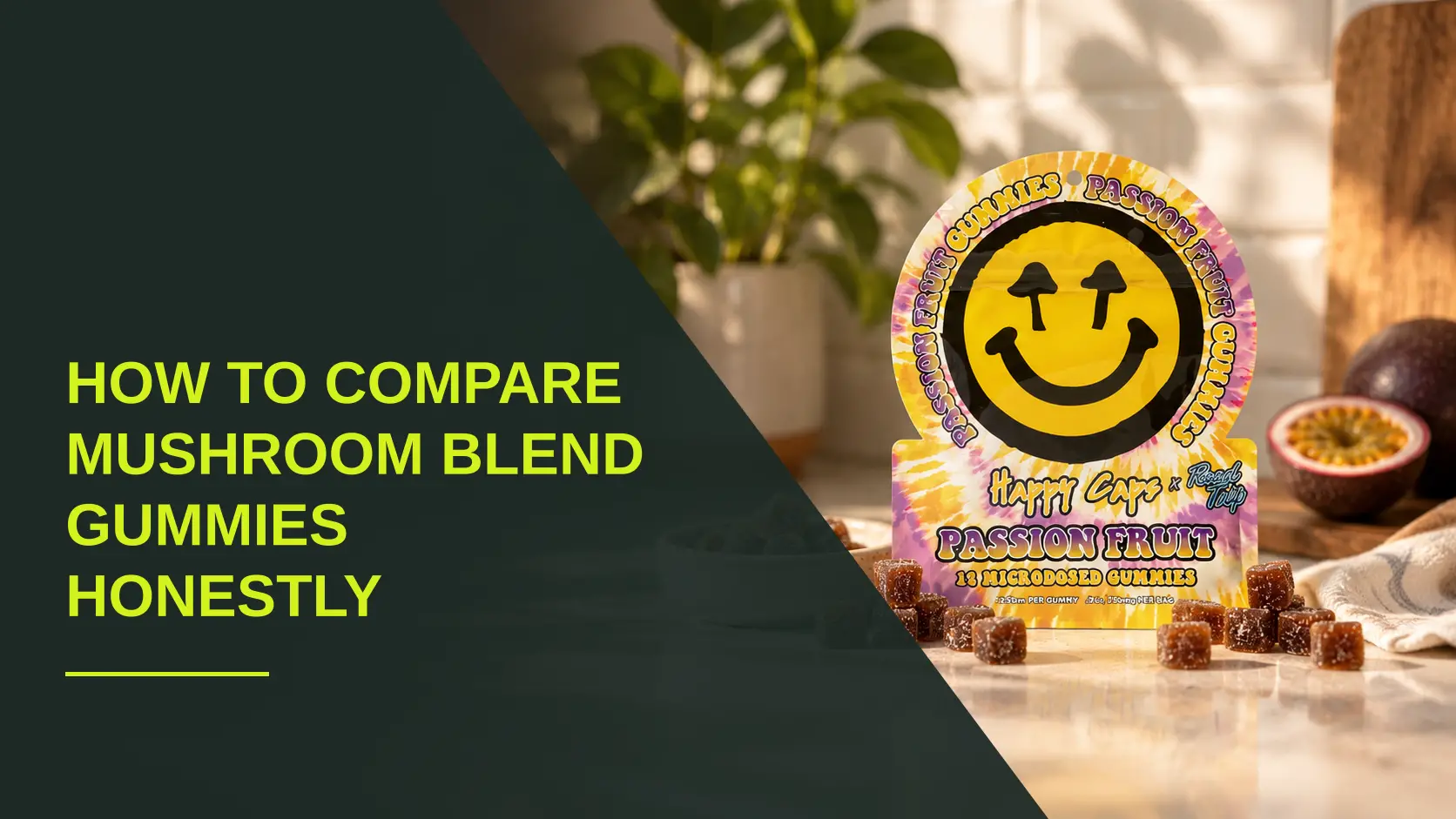
Use these four checks on any product, including the ones in our Mushroom Blends Gummies category. Purely Found carries options such as Road Trip Desert Stardust Mushroom Gummies and Happy Caps x Road Trip Microdosed Gummies. Each has its own formula, so check every product page individually instead of assuming one brand's label describes another's.
1. Read the full ingredient list
Start with the back of the package, since the front is marketing.
- Look for named species. "Lion's mane (Hericium erinaceus)" tells you something. "Mushroom complex" doesn't.
- Check which part of the mushroom was used. The fruiting body is the part you'd recognize as a mushroom. Mycelium is the root-like network it grows from, and it's often grown on grain, some of which can end up in the final powder. They're different ingredients, and the label should say which one you're getting.
- Note whether it's an extract or a whole powder. An extract concentrates certain compounds using hot water, alcohol, or both. A powder is dried, ground mushroom. 250 mg of extract and 250 mg of powder aren't equivalent amounts.
- See whether each species has its own amount. A proprietary blend gives one total for everything, so you can't tell if the mushroom you care about makes up most of the gummy or a trace of it.
- Read the "other ingredients" line. This is where you'll find the sweeteners, whether the gummy is set with gelatin or pectin (pectin is the plant-based one), and any added botanicals or active compounds.
Some labels also list beta-glucans, a group of compounds researchers often measure in these mushrooms. A stated beta-glucan percentage tells you more than a "polysaccharides" figure, which can include ordinary starch.
2. Check the serving size
The big number on the front is often per serving, and a serving isn't always one gummy. If the label says 1,000 mg per serving and a serving is two gummies, each gummy has 500 mg. Find the per-gummy figure before you compare anything.
Then look at servings per container. A 20-count bag at two gummies per serving is 10 servings, which changes the math on price. Comparing cost per serving is fairer than comparing cost per bag.
For Amanita muscaria gummies, the number that matters is milligrams of muscimol per gummy. A figure for total "Amanita extract" doesn't tell you the same thing. Our muscimol gummies label guide shows where to find it.
Whatever the product, treat the label's suggested serving as your reference point. It's the amount the manufacturer built the product around.
3. Look for a COA (third-party lab results)
A COA, or certificate of analysis, is a report from a laboratory showing what was found in a specific batch of product. "Lab tested" on a package means little until you can see the report. To read one:
- Match the batch or lot number on the COA to the one printed on your package. A report for a different batch tells you about a different batch.
- Confirm the lab is independent of the brand. The lab's name and accreditation (often ISO/IEC 17025) should be on the report.
- Check the date. A report from several years ago probably isn't about the product in your hand.
- Look at what was tested. Useful panels include the active compounds the label claims, heavy metals, microbial contamination, and pesticides. Mushrooms readily absorb metals from whatever they grow on, so the heavy metals panel deserves a look.
- Compare the results with the label. If the package says 5 mg of muscimol per gummy, the potency result should land close to that.
Many brands post COAs on their site or link them through a QR code on the package. If a seller can't produce one when asked, treat that as information about the product.
4. Confirm what kind of product it is
By this point you should be able to finish this sentence: "This gummy contains ___ at ___ per piece." If you can't, the label hasn't told you enough.
A clear product names its active ingredients in plain words. For a functional blend, that means species and amounts. For an Amanita muscaria gummy, it means muscimol in milligrams. Some blends combine mushrooms with other active botanicals, and those should be named with amounts too.
Be cautious with products that describe only an effect. If the front gives you a name and a mood and the back states no actives, you can't compare the gummy with anything or know what a serving contains. That is reason enough to keep looking.
Do this check before you buy, since a functional blend and a psychoactive product call for very different planning.
Quick comparison table
The four checks, side by side:
| Checklist point | What a clear label shows | What should give you pause |
|---|---|---|
| Ingredient list | Named species, the part used, extract or powder, and an amount for each | "Proprietary blend" with one total and no breakdown |
| Serving size | Amount per gummy, amount per serving, and servings per container | A big per-serving number that hides a multi-gummy serving |
| COA | A recent report from an independent lab, matched to your batch number | No report, an in-house report, or one for a different batch |
| Product type | A plain statement of the mushrooms and active compounds inside | Effect-only marketing with no stated actives |
How to start gently with mushroom gummies
Once a product passes the checklist, go slowly with it.
Begin with the serving on the label, or the lower end if it gives a range. Try one new product at a time. If you start two blends in the same week, you won't know which one you're responding to.
Gummies are digested, so follow the label's guidance on timing and give a serving the full time it describes before deciding anything. Taking a second serving because the first hasn't registered yet is the usual way people end up with more than they intended.
Effects vary from person to person, and some people notice very little from functional mushrooms. Many people report that a few lines of notes help: what they took, how much, when, and anything they noticed over the following days. With psychoactive products, pick a day with nothing demanding on it and plan not to drive.
Keep gummies sealed in their original packaging, in locked storage, out of reach of children and pets.
If gummies turn out not to be your format, the same four checks apply to capsules, powders, and chocolates. Our guide to mushroom supplement formats compares them.
FAQs
What are mushroom gummies made of?
A gummy base (sweetener, water, and gelatin or pectin) plus mushroom powder or extract. Functional blends typically use species such as lion's mane, reishi, or cordyceps. Amanita muscaria gummies use an extract that should be labeled by muscimol content. Some products add other botanicals, so read the full ingredient list.
Are functional mushroom gummies the same as Amanita muscaria gummies?
No. Functional mushroom gummies use species like lion's mane and reishi. Amanita muscaria gummies are psychoactive and are measured by their muscimol content. They're different products with different labels to read. Browse Amanita muscaria gummies separately from blends, and don't treat one as a stand-in for the other.
How do I read a COA for mushroom gummies?
Match the batch number to your package, confirm an independent lab ran the tests, check the date, and compare the results against the label's claims. Look for heavy metals and microbial panels alongside the active compound results.
How many mushroom gummies should I take?
Follow the serving size on the label for that specific product, and start at the low end if there's a range. Amounts aren't transferable between products, since two gummies of the same size can hold very different ingredients.
What if I took more than the label suggests?
Effects vary from person to person and pass with time. If you're worried about how you or someone else is feeling, contact a medical professional or Poison Control.
Is a proprietary blend a bad sign?
Not necessarily. But a single total with no breakdown means you can't compare the product with others or know how much of each mushroom you're getting. A COA can sometimes fill in part of what the label leaves out.
Feel different. Live curious.
The best mushroom gummies for you are the ones whose label answers all four questions clearly: what's in it, how much is in each gummy, who tested it, and what kind of product it is. Take the checklist to any product page and see how it holds up. If you have questions about a specific label or lab report, ask our team online or stop by one of our two North Carolina stores, in Charlotte and Matthews.