Search for mushroom chocolates and you'll find bars that share a name and very little else. One is a milk chocolate square with lion's mane and reishi extracts. Another is built around Amanita muscaria, a psychoactive mushroom. A third lists a "proprietary blend" and leaves it there. The wrappers can look almost identical.
The label is the most reliable way to tell them apart. This guide explains what mushroom chocolates are, how to read an ingredient list, and how to make sense of serving sizes, with the Road Trip chocolate bars we carry as the example. It's written for people who are new to the category and for people who have tried a few bars and want to compare them more carefully.
Table of contents
- What are mushroom chocolates?
- What mushroom blend chocolates don’t contain
- How to read a mushroom chocolate ingredient list
- How to read serving sizes on mushroom chocolates
- Lab results and transparent sourcing
- Mushroom chocolates vs. other formats
- Before you try mushroom chocolates
- FAQs
- Explore at your own pace
What are mushroom chocolates?
Mushroom chocolates are chocolate bars or pieces with mushroom ingredients mixed in, usually as a powder or an extract. Sometimes other botanicals are added too. The chocolate is the format. What shapes your experience is which mushrooms are in the bar, in what form, and how much.
That's where the vocabulary gets slippery.
Mushroom blend, functional mushrooms, mushroom-inspired: what the terms mean
These three phrases show up on packaging and product pages, and they don't mean the same thing.
"Functional mushrooms" is an informal name for species people use for reasons beyond flavor: lion's mane, reishi, cordyceps, chaga, turkey tail and a few others. Several have long histories of use. Reishi, for example, has been part of traditional practice in China, Japan and Korea for centuries. The term isn't a regulated category, and it tells you nothing about quality or amount.
A "mushroom blend" is a formula that combines more than one mushroom ingredient, sometimes alongside other botanicals. A blend can be made entirely of functional mushrooms, or it can include a psychoactive ingredient such as Amanita muscaria. The word "blend" won't tell you which, so the ingredient panel has to. Our guide to what mushroom blends are goes deeper on this.
"Mushroom-inspired" tells you the least. It may describe a product built around mushroom extracts, or one where mushrooms are a small part of a formula that leans on other botanicals.
Amanita muscaria products are their own category with their own considerations. If you're sorting out the difference, Mushrooms 101 lays the categories side by side.
Why chocolate?
Mostly taste. Many mushroom powders are earthy and bitter, and cacao covers that well. Chocolate is also easy to portion, since a bar scored into squares gives you a built-in unit to measure by. And it's familiar. Nobody needs instructions for eating a piece of chocolate.
Format changes things, though. A chocolate bar carries sugar, fat and cacao along with the mushrooms, and it's digested as food, so it may land differently from a capsule or a tea made from the same ingredients. You can see the bars we carry in mushroom blend chocolates.
What mushroom blend chocolates don't contain
The phrase "mushroom chocolates" is used online for several unrelated kinds of product, so people often ask what is and isn't in a blend bar.
The mushroom blend chocolates at Purely Found are made from the ingredients named on their labels, and they are not made with federally controlled substances.
You shouldn't have to take any seller's word for that, ours included. Two documents let you check for yourself. The first is the ingredient panel, which should name what went into the bar. The second is a third-party lab report, which shows what an independent lab found when it tested a batch. If a bar contains a psychoactive ingredient such as Amanita muscaria, the label should say so by name. If a label is vague about what's inside, that vagueness is worth noting.
Both documents are worth learning to read.
How to read a mushroom chocolate ingredient list
Ingredients are generally listed in descending order by weight, so the first few lines tell you what the bar mostly is. For chocolate, that's usually sugar, cocoa butter, milk and cocoa mass. The mushroom ingredients tend to come later or sit in a separate panel.
Look for named mushrooms
A specific label names species: lion's mane, reishi, cordyceps. Some add the Latin name, which removes any doubt about which mushroom is meant. A vague label says "mushroom blend" or "proprietary blend" and gives one total weight for the group.
A proprietary blend isn't necessarily a bad product. It does mean you can't see how much of each ingredient you're getting, and you can't compare the bar fairly against one that spells everything out. A named list is also what lets you work out why a bar sits well or poorly with you.
Extract, fruiting body, or mycelium
The fruiting body is the part most people picture as the mushroom: the cap and stem. Mycelium is the root-like network the mushroom grows from. Commercial mycelium is often grown on grain, and some of that grain can end up in the finished powder. An extract is a concentrate, made by processing either part with hot water, alcohol, or both to pull out certain compounds.
You may also see "beta-glucans" on a label. These are a type of fiber found in mushroom cell walls, and they're among the compounds researchers study most. Some brands list a beta-glucan percentage as a marker of how concentrated an extract is.
Which form is better is not settled. Research comparing fruiting body and mycelium products is still early, and much of the published work on functional mushrooms comes from lab and animal studies or small human trials. A label that tells you the part used and the extraction method gives you more to go on than one that doesn't. That's about as far as the evidence supports going.
Everything else in the bar
Read past the mushrooms. Cacao naturally contains caffeine and theobromine, a related stimulant, and darker chocolate has more of both. That's worth knowing if you plan to have a piece in the evening. Some bars add other botanicals, which should be named individually. Sweeteners vary, and sugar-free bars often use sugar alcohols, which don't agree with everyone's stomach.
Then read the allergen line. Milk and soy are common in chocolate, and many bars are made in facilities that also handle tree nuts, peanuts or wheat.
A worked example: the Road Trip chocolate bar
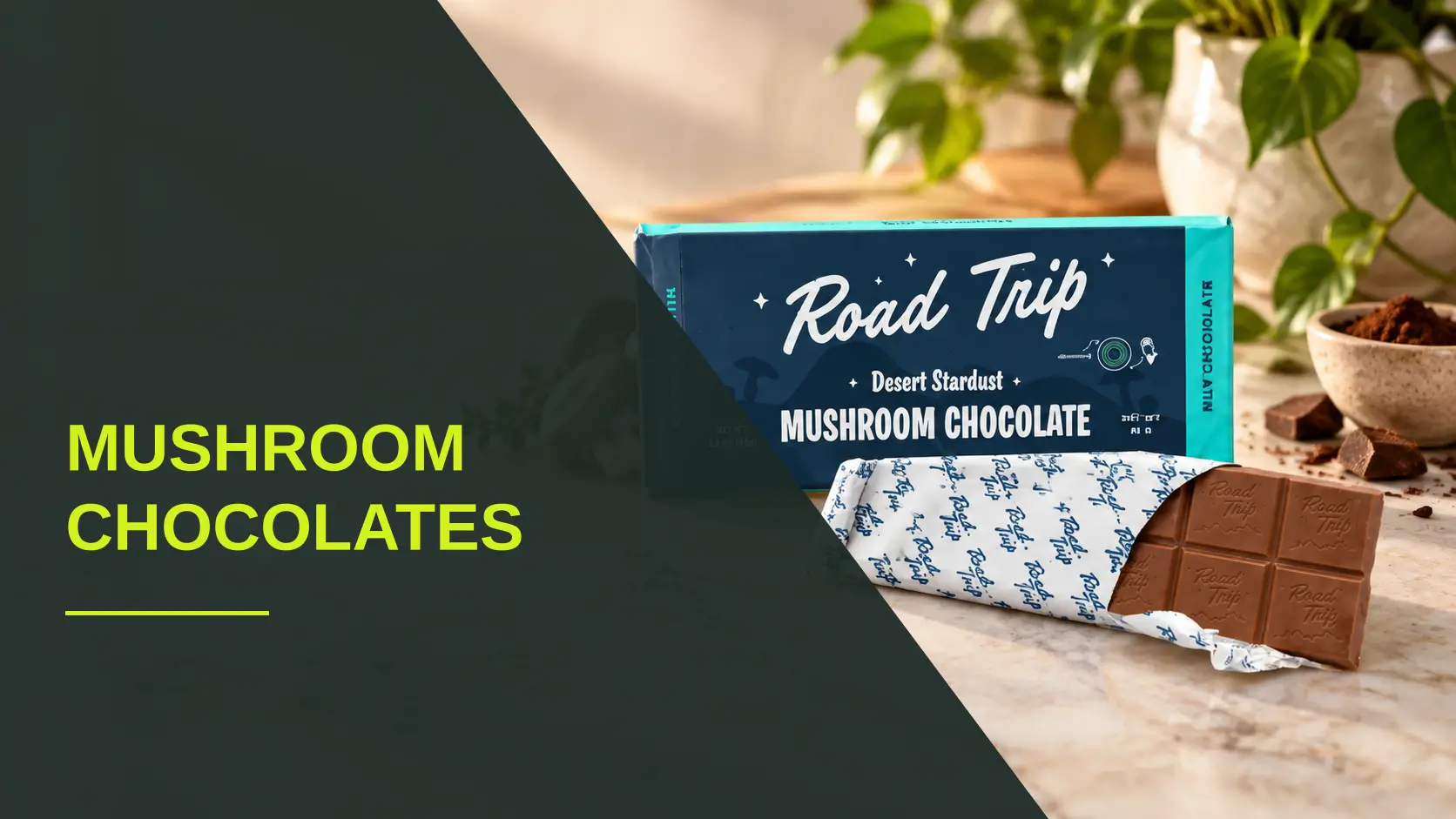
The Road Trip Desert Stardust Mushroom Chocolate Bar comes in three flavors: Milk Chocolate, Cookies & Cream and Strawberry Crunch. Each product page carries the details for that flavor. This is the order we'd read them in.
- Find the mushroom ingredients and see how they're listed: as named species, or as a blend with a single total.
- Check whether the label says which part of the mushroom is used and whether it's an extract.
- Note any other active botanicals in the formula.
- Read the chocolate base and the allergen statement for the flavor you're choosing. Flavors with cookie or crunch pieces often include ingredients, wheat for instance, that a plain milk chocolate bar may not, so don't assume the three panels match.
- Move to the serving information, which the next section covers.
If anything on the panel is unclear, ask us before you buy.
How to read serving sizes on mushroom chocolates
Per piece vs. per bar
A whole mushroom chocolate bar is almost never one serving. The label should give a serving size (one square, two squares, a fraction of the bar) and the number of servings per package. Find both before you break off a piece. Bars that look alike can differ here: one may count a single square as a serving while another counts several.
What the milligrams refer to
A milligram figure printed on the front of a wrapper can refer to different things. It might be the total weight of the mushroom blend in the whole bar, the blend weight in one piece, or the amount of one specific ingredient. The panel on the back usually clears it up.
Do the division yourself if you need to. When a label gives a total for the bar and the number of pieces, dividing one by the other tells you what's in each piece. When a label gives only a blend total, you know the combined weight but not the split between ingredients. Two bars with the same blend total can be very different formulas.
Start gently
Begin with the labeled serving, or less than that if the bar is new to you. Then wait. Chocolate is digested like any other food, so it can take a while before you notice anything, and the timing shifts with what else you've eaten that day. Having a second piece because the first one "isn't working" is a common way people end up taking more than they intended.
Effects vary from person to person. Many people report different experiences from the same serving of the same bar, and your own response can change from one day to the next. Pay attention to how you feel, and make any adjustments slowly across several occasions.
Lab results and transparent sourcing
A third-party lab report is often called a COA, short for certificate of analysis. It's a document from an independent laboratory showing what it found when it tested a sample of the product. Depending on the tests ordered, it may cover the amounts of certain compounds and screens for contaminants such as heavy metals, pesticides and microbes. Mushrooms readily absorb what's in their growing environment, which is why contaminant screening matters for this category in particular.
Check that the lab is independent of the brand, and that the batch or lot number on the report matches the one printed on your bar. A report for a different batch tells you about a different bar.
If a seller can't produce a lab report for a product, that's a good reason to pass on it.
Mushroom chocolates vs. other formats
Chocolate is one way to take a mushroom blend. Capsules, powders, gummies and teas are others, and the differences are mostly practical.
Capsules are the plainest option, with little added beyond the shell, and each one is a fixed amount. Powders give you the most control over quantity, but you'll taste them. Gummies sit closest to chocolate: portioned, flavored, and made with added sweeteners. Chocolate brings cacao's own caffeine and theobromine, and it melts in a warm car or a summer mailbox, which can make the pieces harder to portion evenly.
None of these is the right answer for everyone. Our overview of mushroom supplement formats compares them in more detail, and you can browse mushroom blend gummies if portioned pieces appeal to you but chocolate doesn't.
Before you try mushroom chocolates
Choose your first occasion with some care: a day without obligations, at home, with no driving ahead of you. Don't combine a new bar with alcohol or other substances while you're still learning how it sits with you.
Storage deserves real attention, because these bars look and smell like ordinary chocolate. Keep them in the original labeled packaging, in locked storage, out of reach of children and pets. Chocolate on its own is dangerous for dogs, before any added ingredient is considered. A cool, dry spot inside that locked storage keeps the bar from melting.
If you take more than you meant to, know that effects vary from person to person and pass with time. Anyone who is worried about how they or someone else is feeling should contact a medical professional or Poison Control at 1-800-222-1222. If a child gets into a bar, call Poison Control right away. For a pet, call a veterinarian.
FAQs
What is in mushroom chocolates?
Chocolate plus mushroom ingredients, usually powders or extracts, and sometimes other botanicals. The specific mushrooms differ from bar to bar. Some use functional mushrooms such as lion's mane or reishi, and some use Amanita muscaria, which is psychoactive. The ingredient panel is where you find out which.
Do mushroom blend chocolates contain controlled substances?
The mushroom blend chocolates at Purely Found are made from the ingredients named on their labels and are not made with federally controlled substances. For any bar from any seller, check the ingredient panel and a third-party lab report matched to the batch number.
How much of a mushroom chocolate bar is one serving?
It depends on the bar. Look for the serving size and servings per package on the label, since a full bar usually holds several servings. Start with the labeled serving or less, and give it time before deciding whether to have more.
How should mushroom chocolates be stored?
In the original labeled packaging, in locked storage, out of reach of children and pets. They look like ordinary chocolate, so the label matters. Keep the bar cool and dry, because melted and re-hardened chocolate is harder to portion evenly.
Explore at your own pace
There's no deadline on any of this. Read a few labels, compare a couple of bars, and ask us when something on a panel doesn't make sense. Our team is glad to talk it through online or in person at our two North Carolina locations, Charlotte and Matthews.
Feel different. Live curious. For us, that begins with knowing what's in the bar you're holding.
Shop Mushroom Blend Chocolates